
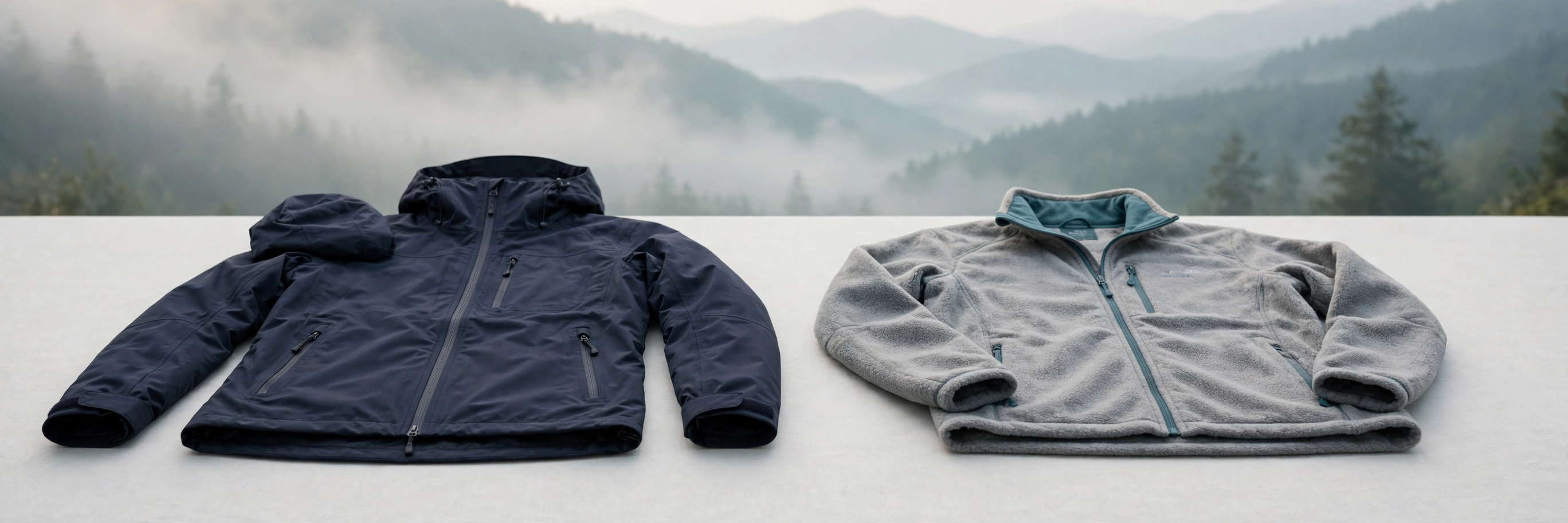
A 3-in-1 jacket combines a weather-protective outer shell, a removable insulating liner and the attachments that join them. Start your OEM brief with the end use, then specify each piece and approve a sample that fits and works in all three wear modes.
Wisp Outdoor develops shell-and-liner programmes in Ningbo for outdoor brands, importers and uniform buyers. This guide covers the construction, test methods and sampling decisions that help you compare quotations and approve the finished system.
What is a 3 in 1 jacket? One system, three ways to wear it
A 3-in-1 jacket combines two garments that connect with a compatible zip (and usually snap loops at the cuffs and neck): an outer shell that handles wind and rain, and an inner liner jacket that provides warmth. Worn together they make a winter jacket. Worn apart, each one works on its own. That is the whole commercial logic of the category — one purchase, one SKU on your rail, three seasons of use for your customer.
| Wear mode | Combination | Best for |
|---|---|---|
| 1. Shell alone | Waterproof outer only | Rain, wind and mild weather; spring and autumn |
| 2. Liner alone | Fleece or insulated inner only | Dry, cold days; travel, commuting and layering |
| 3. Combined | Liner zipped into the shell | Cold plus wet or windy weather; winter |
For a buyer, the system has a second advantage: range planning. A single 300-piece programme can anchor a multi-season offer instead of forcing you to commit separately to a shell programme and an insulated programme, each with its own minimums, fabrics and sampling rounds. The trade-off is discipline — shell and liner must be developed together, as one product, from the first proto. Treating the liner as an afterthought is the most common mistake in this category, and the section on the zip-in interface below explains why.
For a starting point, compare the Wisp OEM 3-in-1 jacket range and the 3-in-1 Weather System Jacket.
Who buys 3-in-1 jackets — and what each buyer must specify differently
- Outdoor and lifestyle brands: You sell one system across autumn, winter and spring, so shell colourways and liner colours must work both combined and standalone.
- Uniform and workwear buyers: Your customer wears the shell and liner separately at work, so standalone appearance, branding placement on both garments, hi-vis or uniform colour options, and easy care matter as much as peak warmth.
- Importers and private-label buyers: Your margin lives in the specification. A small change — 3-layer instead of 2.5-layer shell, down instead of synthetic liner — moves unit cost far more than the silhouette does. Lock the spec before you compare quotations.
Choose the liner first: fleece, synthetic, 90% down or 50% down
Most briefs start with the shell. Start with the liner instead. The liner decides how warm the combined jacket feels, how the standalone inner jacket looks on your rail, how the product washes, and a large part of the unit cost. As a zip-in liner jacket manufacturer, these are the four options we develop most often.
| Liner type | Warmth & best use | Strengths | Watch out for |
|---|---|---|---|
| Fleece | Light–mid warmth; mild winters, layering | Low cost, easy care, breathable, works well standalone | Least warm option; can look basic if weight/finish is too low |
| Synthetic insulated | Mid–high warmth; wet-cold climates | Keeps insulating when damp, easy care, vegan positioning | Bulkier than down at equal warmth; specify fill weight, not just “padded” |
| 90% down | High warmth-to-weight; cold winters, premium ranges | Warmest and lightest, packs small, premium hand feel | Highest cost; needs fill power, fill weight and down/feather ratio in the brief; care and sourcing documentation |
| 50% down | Mid–high warmth; value-premium ranges | Warmer feel than synthetic at moderate cost | Less loft than 90% down; confirm ratio and fill weight — “down jacket” alone is not a specification |
Read insulation the way the insulation brands publish it — each system has its own ladder, and the ladders do not convert into each other.
| Insulation system | The ladder, as published | What actually decides warmth |
|---|---|---|
| Down | Fill power roughly 450–900 (higher = more loft per gram) | Fill power × fill weight, together. A high fill-power down at a low fill weight can be less warm than a mid fill-power down filled heavier. Always specify both, plus the down/feather ratio. |
| Synthetic — e.g. PrimaLoft Gold Eco | Sold in fixed weights: 40 / 60 / 80 / 100 / 133 / 170 / 200 g/m² | The g/m² weight you choose. 40–60 g/m² is a light liner; 100 g/m² is a solid winter liner; 170–200 g/m² is a heavy, low-activity liner. Heavier also means bulkier inside the shell. |
| Fleece — e.g. Polartec Classic | Class names: Micro, 100, 200, 300 | The class is a name, not a g/m² figure — do not write “Polartec 200 = 200 g/m²” in a spec. Specify the class and require the fabric's actual g/m² on the material sheet. 100 is light, 200 is the versatile middle, 300 is heavy and bulky. |
If you specify down, specify its sourcing standard as well. The Responsible Down Standard (RDS), version 3.0, managed by Textile Exchange, prohibits live-plucking — including molt-harvesting — and prohibits force-feeding, with third-party auditing and chain-of-custody tracking from farm to finished product. “Down liner” without a ratio, a fill power, a fill weight and a sourcing standard is four missing specifications, not one.[14]
Three rules when you specify a liner. First, always state the insulation quantitatively: fleece weight in g/m², synthetic fill weight in g/m², or down by ratio (for example 90/10 down/feather), fill power and fill weight. “Warm liner” is not a specification a factory can price or reproduce. Second, design the liner as a standalone jacket — finished front zip, pockets, binding or cuff finish, and your branding — because your customer will wear it alone for much of the season. Third, match liner bulk to shell fit: a high-loft down liner inside a slim shell compresses, loses warmth and strains the connecting zip. Grade the shell with layering allowance whenever a thick liner is planned.
| Buyer tip: If your market is wet-cold rather than dry-cold — much of northern and western Europe, for example — synthetic insulation is often the safer commercial choice even when down looks better on a spec sheet, because it keeps insulating when damp and simplifies care labelling. |
|---|
Build the shell for weather: 2.5-layer vs 3-layer construction
The shell has one job in all three wear modes: keep weather out without making the wearer clammy. Two constructions dominate OEM 3-in-1 programmes.
| Construction | How it is built | Choose it when |
|---|---|---|
| 2.5-layer (2.5L) | Face fabric + membrane or coating + printed / raised protective layer instead of a full lining | Weight and cost matter most; the programme is price-sensitive or packability-led |
| 3-layer (3L) | Face fabric + membrane + knitted tricot backer, laminated as one fabric | Durability, comfort against the liner zip area and a more premium feel matter; the jacket will be worn hard or for uniform use |
A 3L shell usually costs more and weighs slightly more, but the backer protects the membrane from abrasion and body oils, so performance holds up longer — relevant when the combined jacket is your winter hero product. A 2.5L shell is a legitimate choice for a lighter, sharper-priced system; just confirm how the protective print feels and wears, because a tacky or cracking inner print is a visible quality failure.
Membranes work by two completely different mechanisms, and a peer-reviewed review of waterproof breathable fabrics makes the distinction precise (Chang & Liu, 2023, Materials 16, 5339). Hydrophobic microporous membranes are full of tiny pores: they distinguish liquid water droplets — over 100 micrometres across — from gas and vapour molecules, which are under 1 nanometre, letting vapour through the pores while droplets cannot enter. Hydrophilic non-porous membranes have no pores at all: water vapour dissolves into the film on the humid side, diffuses across it, and evaporates on the dry side — a process called solution-diffusion, driven by the humidity difference between inside and outside. That is why a hydrophilic membrane can feel less breathable in cold, dry air (a smaller humidity gradient) and better once the wearer is warm and sweating, while a microporous membrane passes vapour more steadily.[1][2]
The best-known microporous membrane shows how extreme the pore geometry is. Gore describes its expanded PTFE (ePTFE) GORE-TEX membrane as about 0.01 mm thick, with nine billion pores per square inch; each pore is about 20,000 times smaller than a water droplet, yet about 700 times larger than a water-vapour molecule (gore-tex.com). Those three numbers — pore count, droplet ratio, vapour ratio — are the clearest published explanation of why a microporous membrane can block rain and still breathe. They describe Gore's membrane, not every membrane: a generic PU membrane in an OEM programme will not share them, which is exactly why your brief must state the waterproof and breathability targets and test methods you require, rather than writing a famous membrane name and assuming the numbers follow.[8]
Membranes are normally PU (polyurethane) or PTFE-based, in microporous or hydrophilic (non-porous) types. Do not specify by membrane brand name alone. Specify the function you need — waterproof target, breathability target, stretch, hand feel and cost band — and let the factory propose the membrane or coating that meets it in your fabric. If you are still deciding whether your range needs a waterproof system at all, compare constructions in our Hardshell vs Softshell guide (linked at the end of this article) before you lock the brief.
- Face fabric: state composition (polyester or nylon), denier and weave, and whether you need stretch, quiet hand feel or high abrasion resistance.
- Fully taped seams: for a jacket sold as waterproof, require seam sealing on the shell and name it in the brief — an untaped shell with a good membrane still leaks through needle holes.
- Hood, cuffs and hem: state whether the hood is detachable or fixed, adjustable or simple, and how cuffs and hem close. These details change both weather performance and cost.
- Pockets and vents: chest and hand pockets, inner pockets in shell and liner, and pit zips or back vents if your activity level needs them.
See the AU2508 3-in-1 Jacket for a three-layer platform with fleece or down development options. If you are considering a standalone jacket, compare hardshell and softshell construction.