
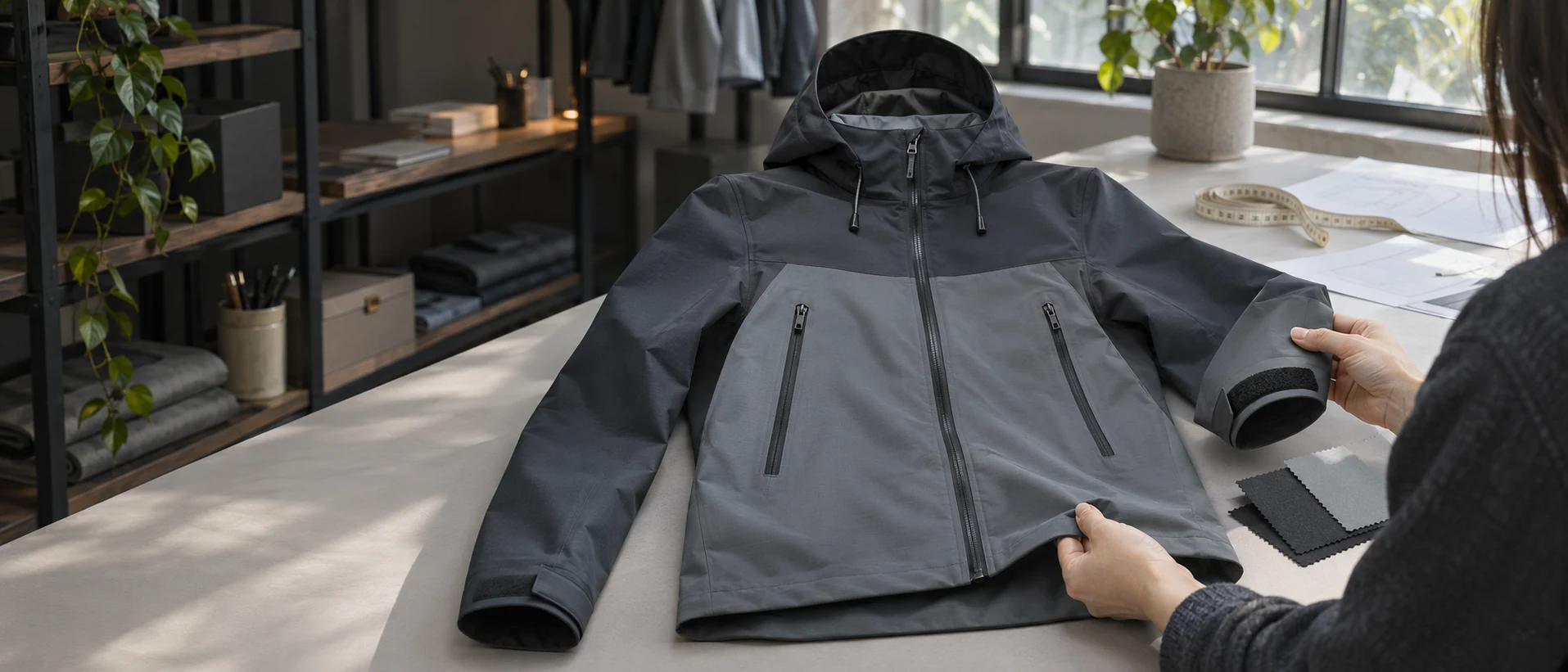
The final approval stage connects initial appearance with performance after care, closes any corrective work, and defines how bulk production will be checked. Keep the sample identity and specification revision attached to every result.
5. Verify performance after the agreed washing and drying
Material identity and baseline results
Wash, dry and document any restoration
Surface, assembly and specified properties
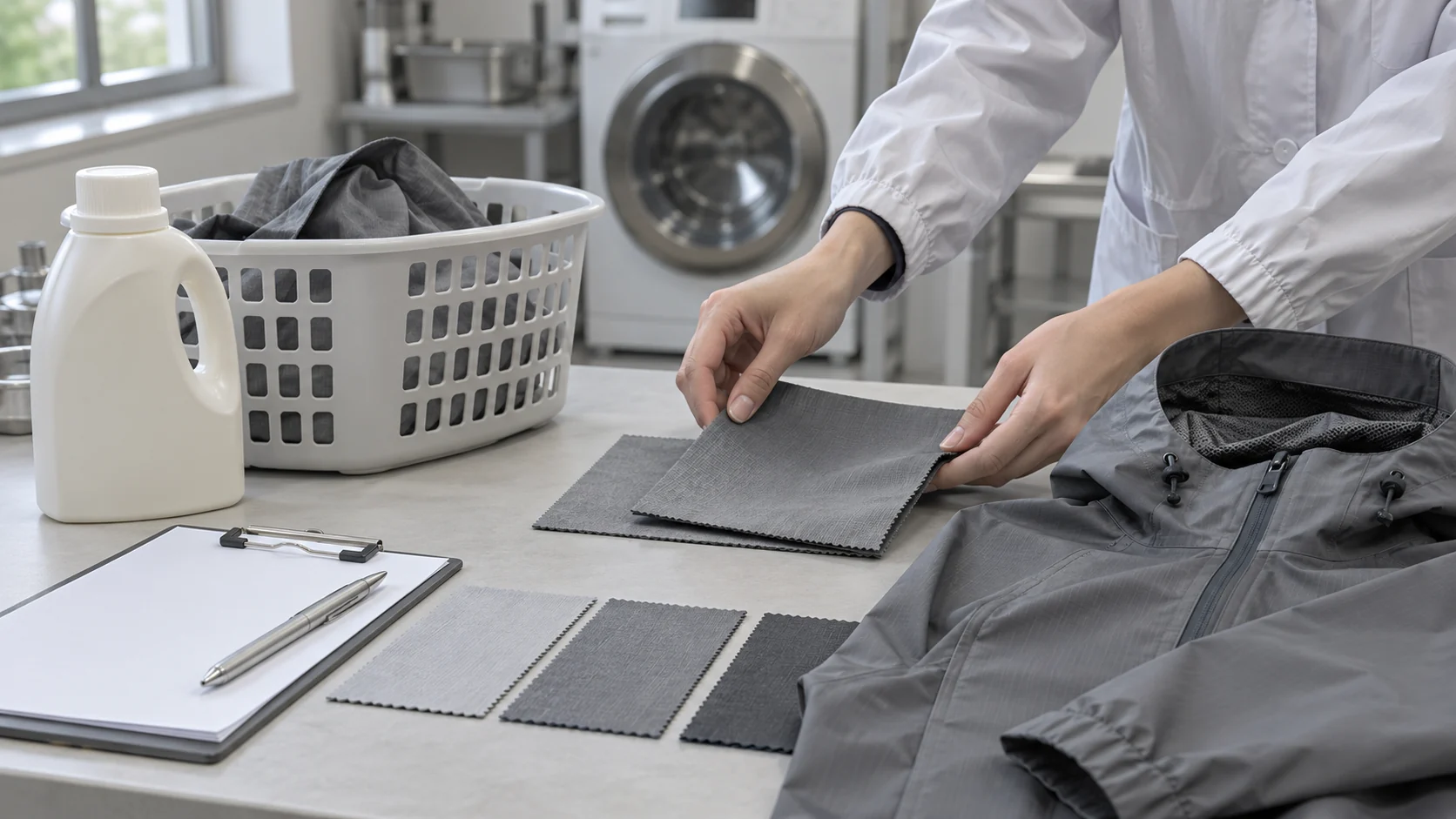
A new sample can establish an initial condition, but the purchasing decision also needs to consider the care expected during use. Agree the washing and drying procedure, treatment count and properties to be assessed afterward. ISO 6330:2021 provides domestic washing and drying procedures for textile testing. It identifies procedural choices that can affect results; it does not supply a universal durability pass threshold for every waterproof jacket. [7]
Be precise about what “after washing” means. Identify the machine or procedure, detergent, drying method and any permitted heat treatment or reproofing. If the question is how the original finish retains performance, adding a new water-repellent treatment changes the question. If the question is whether performance can be restored using the stated care instructions, document that restoration step explicitly. Both can be useful evaluations, provided the report makes their scope clear.
Distinguish wetting out from a demonstrated leak
DWR affects how the outside textile wets. In their 2022 study, Kowalski and colleagues examined five functional clothing materials, three detergents and assessments after 1, 5 and 10 washes. They found that the interpretation of spray-test and contact-angle results could differ, making the choice of assessment important. The study concerns particular materials and finishes; its results do not mean that every jacket fails after a fixed number of washes or that every modern fluorine-free finish behaves alike. [2]
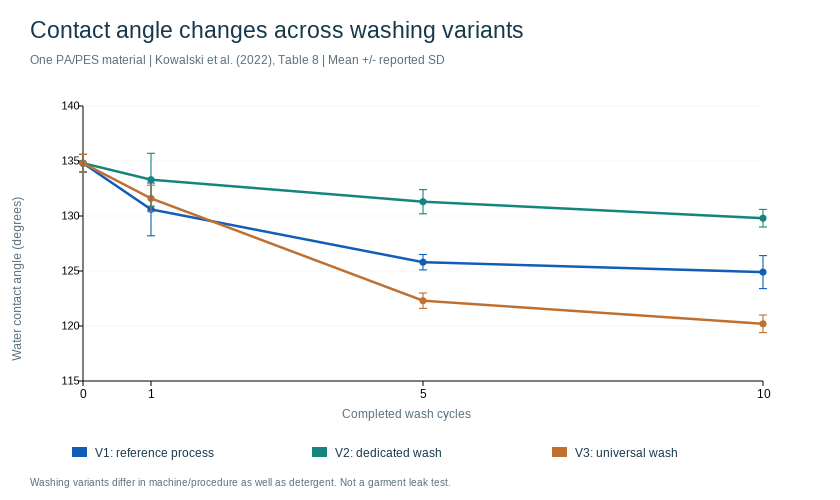
For the PA/PES specimen under V3, the mean water contact angle remained 120.2° after ten washes. The paper nevertheless reports complete surface wetting in the spray assessment of that treated specimen. The two observations can coexist because a static droplet and a dynamic spray assess different behavior. This is a reason to retain both the method and the result when reviewing a surface-repellency claim. [2]
Read the contact-angle values used in this figure
| Washes | V1 (degrees) | V2 (degrees) | V3 (degrees) |
|---|---|---|---|
| 0 | 134.8 ± 0.8 | 134.8 ± 0.8 | 134.8 ± 0.8 |
| 1 | 130.6 ± 2.4 | 133.3 ± 2.4 | 131.6 ± 1.2 |
| 5 | 125.8 ± 0.7 | 131.3 ± 1.1 | 122.3 ± 0.7 |
| 10 | 124.9 ± 1.5 | 129.8 ± 0.8 | 120.2 ± 0.8 |
The purchasing implication is to request the result that corresponds to the claim. A surface that no longer beads water needs a surface-wetting assessment and a review of the care state. A suspected passage of water through a material, seam or opening requires an investigation suited to that path. Dampness reported by a wearer deserves attention, but the location, exposure, activity and clothing configuration should be recorded before assigning a cause.
Official GORE-TEX care guidance also explains washing, drying and, where appropriate, restoring water repellency. It includes construction-specific exceptions, so it should not be copied into a universal care label for unrelated products. For a new order, the supplier needs to establish suitable instructions for the actual materials and trims, then provide the evidence agreed in the development brief. [11]
Inspect the assembly as well as the finish
After the agreed treatment, re-examine the sample for tape lifting, visible separation, puckering, dimensional change and changes in closure operation or adjustment. Record the observations alongside the relevant retest results. If the purpose is to compare initial and treated specimens, make sure the specimens and preparation are sufficiently comparable for that conclusion. Where destructive testing is needed, agree a suitable sample allocation with the laboratory.
Wei and colleagues’ 2023 washing study provides another reason to specify the procedure carefully. Their experiments used assemblies made from three commercial outer fabrics and a fleece inner material, examining washing conditions and functional changes. Those assembled specimens were not a complete range of finished hard shells. The study supports attention to washing conditions and the balance between cleaning and damage; it does not establish one optimal household recipe for all jackets. [3]
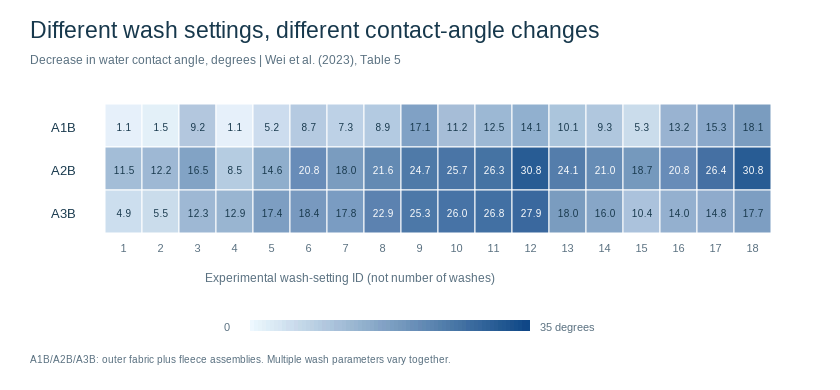
The spread across setting IDs shows why “washed once” is an incomplete preparation description. Several parameters change between the study’s settings, so the heatmap cannot assign the difference to temperature alone or supply a universal care recipe. Use it to frame the questions about procedure and material identity that the supplier’s report needs to answer. [3]
Read all reported ΔWCA values in this heatmap
| Setting ID | A1B (degrees) | A2B (degrees) | A3B (degrees) |
|---|---|---|---|
| 1 | 1.1 | 11.5 | 4.9 |
| 2 | 1.5 | 12.2 | 5.5 |
| 3 | 9.2 | 16.5 | 12.3 |
| 4 | 1.1 | 8.5 | 12.9 |
| 5 | 5.2 | 14.6 | 17.4 |
| 6 | 8.7 | 20.8 | 18.4 |
| 7 | 7.3 | 18.0 | 17.8 |
| 8 | 8.9 | 21.6 | 22.9 |
| 9 | 17.1 | 24.7 | 25.3 |
| 10 | 11.2 | 25.7 | 26.0 |
| 11 | 12.5 | 26.3 | 26.8 |
| 12 | 14.1 | 30.8 | 27.9 |
| 13 | 10.1 | 24.1 | 18.0 |
| 14 | 9.3 | 21.0 | 16.0 |
| 15 | 5.3 | 18.7 | 10.4 |
| 16 | 13.2 | 20.8 | 14.0 |
| 17 | 15.3 | 26.4 | 14.8 |
| 18 | 18.1 | 30.8 | 17.7 |
Use the results to make a development decision. An unacceptable change may call for a different material combination, a revised assembly process, a more suitable care instruction or further investigation. A revised component or instruction should trigger a review of the affected approval items. Keeping the pre-treatment and post-treatment evidence together makes the reasoning visible to both buyer and supplier.
6. Turn a defect observation into a verified correction
Location, condition and sample ID
Cause, change and affected items
Resubmission, evidence and closure
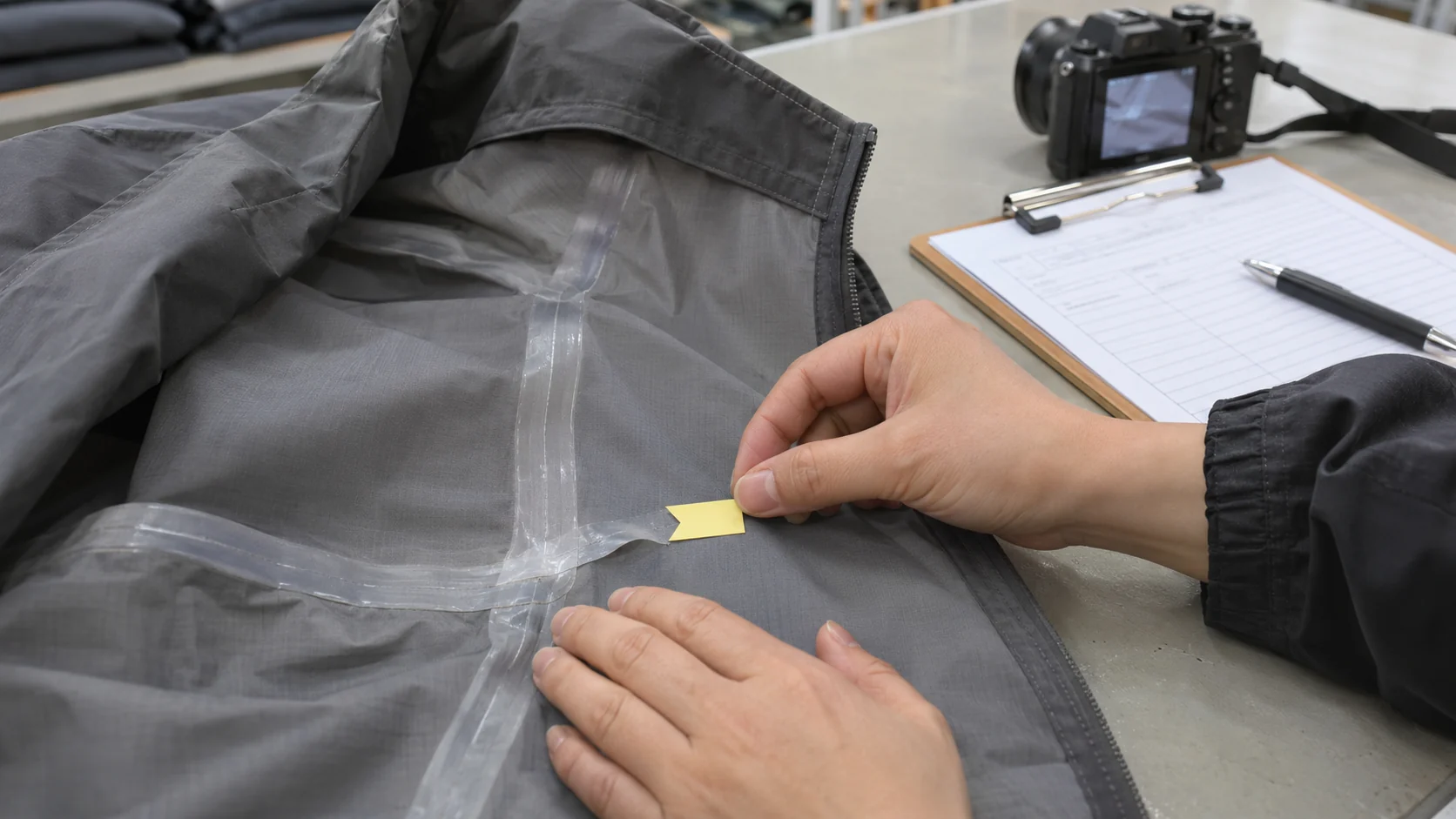
A useful defect report explains what happened, where it happened and under which conditions. Identify the sample and revision, inspection date, garment location and care state. Add a clear photograph with orientation and, when relevant, a scale. Describe the observation in neutral terms: “tape edge lifted at the left underarm after the agreed wash procedure” gives a supplier something concrete to investigate.
Agree how the concern affects the product’s intended use and the approval decision. A team may classify defects by severity, but the definitions need to be agreed for the program. A general cosmetic category should not automatically absorb a concern that affects required weather protection, closure operation or safe use. Conversely, an appearance observation does not become a confirmed functional failure without the evidence needed to establish that conclusion.
Ask for the cause and the correction
For the lifted-tape example, ask the supplier to investigate the assembly and the relevant process records. The investigation may need to consider material compatibility, seam geometry or application control. These are lines of inquiry, not a diagnosis made from a photograph. Request an explanation of the identified cause, what will change, how the revised sample will be identified and which checks will demonstrate the correction.
If the proposed solution changes a tape, material or seam construction, review the consequences for the rest of the specification. A repair to the submitted sample and a correction to the bulk production process are different actions; both may need verification. Keep the original observation and the subsequent results so that a later reviewer can follow the decision without relying on memory.
Keep sample approval distinct from lot acceptance
Approving a development or production-intent sample does not inspect every garment in a future delivery. For bulk, agree the lot definition, inspection characteristics, defect classifications, sampling approach and disposition rules. ISO 2859-1:2026 describes AQL-indexed sampling schemes for inspection by attributes. The NIST handbook explains that acceptance sampling involves probabilities of accepting or rejecting lots at different quality levels, including risks for both producer and buyer. [9][10]
This is why an AQL value should not be read as a promise that an individual shipment contains exactly that percentage of defects, or as proof that all functional properties have been tested. Define the separate performance-testing plan and its sampling requirements with the relevant laboratory. Include inspection and testing records in the same program file while preserving what each result actually demonstrates.
Close a corrective item when the agreed evidence supports closure. A supplier’s statement that a problem has been fixed is a useful response, but the buyer still needs the promised measurement, inspection or retest record. If the change introduces another issue, retain both records and evaluate the revised sample as a new configuration where appropriate.
7. Approve a defined sample and retain the decision record
Specification and components
Fit, performance and corrections
Inspection and testing plan
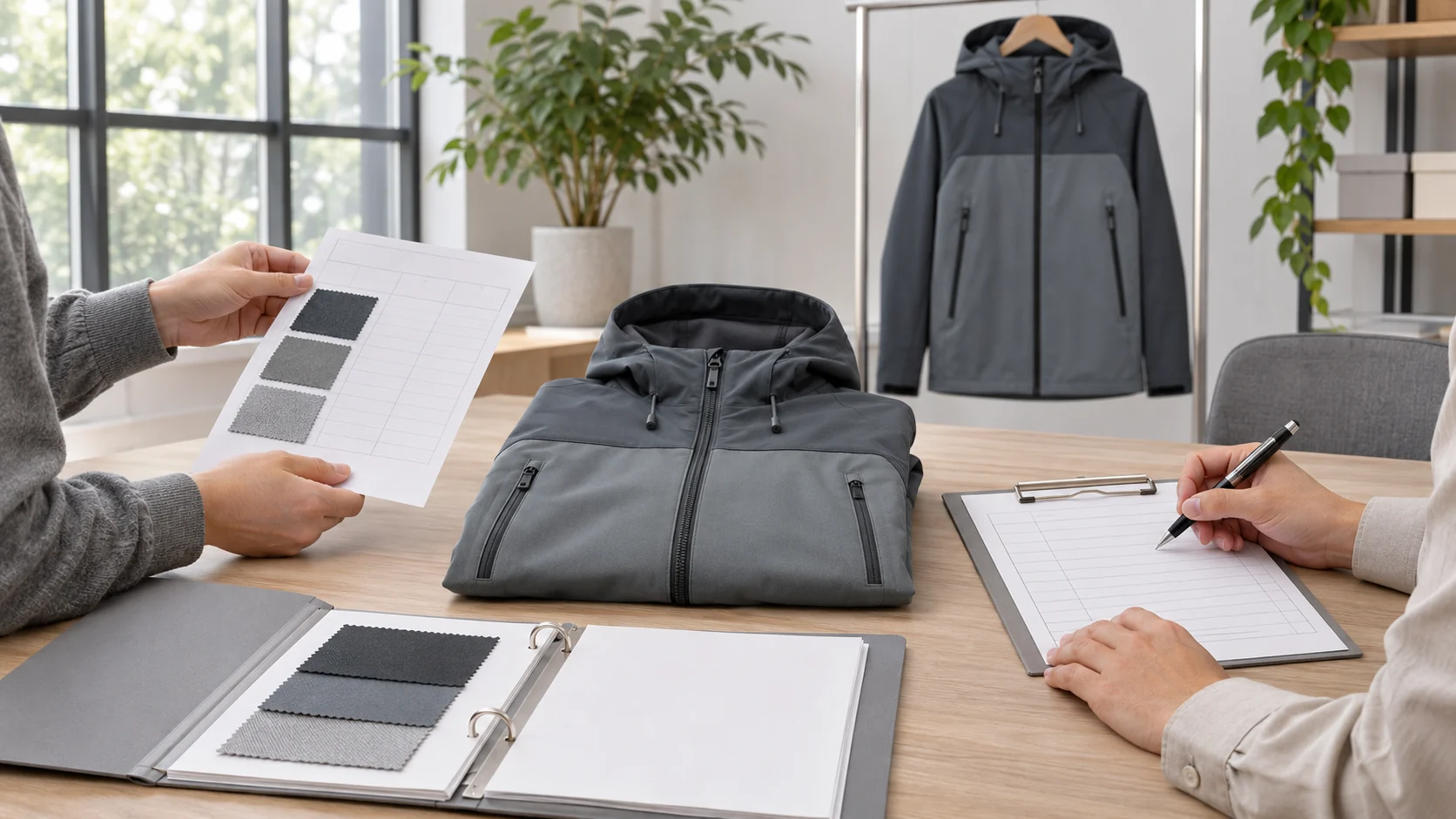
The final approval record should identify the garment, specification revision, material and trim references, and the results used to support the decision. State any unresolved items and exactly how they affect production authorization. If the buyer allows a particular activity to proceed while another remains pending, describe that limited permission explicitly. Avoid an ambiguous “approved” message that different teams may interpret differently.
Retain a clearly identified reference sample where practical and agree how it will be used. Photographs and approved documents remain important because a physical sample can age, be damaged or become separated from the records. Where the garment contains an accepted deviation, document it in writing; otherwise an inspector may mistake that feature for an unapproved variation.
A practical waterproof jacket sample checklist
The checklist below brings the evidence together. Complete it with the agreed methods and acceptance criteria for the order. It is a starting structure for a buyer’s record, not a replacement for a laboratory method or market-specific requirements.
| Item | What the record should answer | Evidence to retain |
|---|---|---|
| Sample identity | Which revision and component list were inspected? | Sample ID, specification and substitution list |
| Measurements and fit | Does it meet agreed dimensions and movement needs? | Measurement sheet, layers and try-on notes |
| Fabric properties | Do the reports correspond to the proposed assembly? | Material references and relevant reports |
| Seams and openings | Is construction consistent with the agreed specification? | Location photographs and verification results |
| Care durability | What changed after the specified treatment? | Wash/dry record and before/after assessment |
| Corrective actions | Were the identified concerns resolved and rechecked? | Cause, revision and closure evidence |
| Bulk control | What inspection and testing will apply to production? | Agreed lot inspection and test plan |
Plan the handover as part of the OEM outerwear production process. The approved component list, measurement definitions and defect examples should be available to the people carrying out bulk inspection. If a supplier proposes a change after approval, use a change-control record to identify which evidence must be reviewed again.
When shortlisting designs, browse the hardshell jacket range and identify the aspects of a reference that matter to the project. For example, the published AY-2501 Technical Bonded Shell page can support a discussion about the desired design direction. Ask separately for the material, construction and performance evidence applicable to the proposed order.
A productive enquiry includes the intended wearer and activity, target market, expected layers, quantities, size range, product reference and claims that need support. Send those details through the Wisp project enquiry form so that sampling and the evidence required for approval can be discussed together.
Questions buyers ask before approving a waterproof jacket
Is a high waterproof rating enough to approve the jacket?
A fabric result answers a question about the tested specimen under stated conditions. Approval also needs the evidence agreed for garment construction, fit and care durability. Read the scope of the report and determine which product questions remain open.
How many washes should a sample pass?
Agree the count, washing and drying procedure, assessment properties and required results for the product program. A paper’s chosen wash count is an experimental condition, not automatically the correct acceptance requirement for a different jacket.
Does water soaking into the outside mean the membrane is leaking?
Surface wetting alone does not establish passage through the barrier. Record the care state and suspected water path, then use the appropriate assessment for the surface, material or complete garment.
Can a visual seam inspection replace a performance test?
Visual inspection can identify construction concerns and locations for follow-up. It does not provide the pressure resistance or rain-exposure result that a specified test is intended to measure.
Can I use the same sample for every check?
Plan the sequence with the supplier and laboratory. Washing, destructive testing and rework can alter the sample. Allocate additional garments or specimens when needed and keep each result linked to its preparation and identity.
References and PDF downloads
Research findings below relate to the specimens and conditions in the cited work. They are used to explain evaluation choices and are not test results for Wisp products.
- Cha, H. C., Park, J. H., Lim, J. Y., & Shim, H. S. (2015). Garments Waterproofness Test Using Rain Tower System. Fashion & Textile Research Journal, 17(6), 1013–1019. PDF. Korean full text with an English abstract.
- Kowalski, M., Salerno-Kochan, R., Kamińska, I., & Cieślak, M. (2022). Quality and Quantity Assessment of the Water Repellent Properties of Functional Clothing Materials after Washing. Materials, 15(11), 3825. PDF.
- Wei, Y., Zhang, H., Su, Z., Tao, S., Cao, X., Wan, Z., & Pan, W. (2023). Develop an optimal daily washing care for technical jacket by balancing washing efficiency and functional degradation. Journal of Engineered Fibers and Fabrics, 18, 1–16. PDF.
- Macit, A. Ş., & Tiber, B. (2019). Investigation of Water Permeability of Ultrasonic Seaming on PU Coated Fabrics. International Periodical of Recent Technologies in Applied Engineering, 1, 25–29. PDF.
- ISO. ISO 811:2018 — Textiles: Determination of resistance to water penetration — Hydrostatic pressure test. Official scope and standard access.
- ISO. ISO 4920:2012 — Textile fabrics: Determination of resistance to surface wetting (spray test). Official scope and standard access.
- ISO. ISO 6330:2021 — Textiles: Domestic washing and drying procedures for textile testing. Official scope and standard access.
- ISO. ISO 24231:2024 — Protective clothing: Protection against rain — Test method for ready-made garments against high-energy droplets from above. Official scope and standard access.
- ISO. ISO 2859-1:2026 — Sampling procedures for inspection by attributes: AQL-indexed schemes for lot-by-lot inspection. Official scope and standard access.
- NIST/SEMATECH. e-Handbook of Statistical Methods, 6.2.2: Lot Acceptance Sampling Plans. Process or Product Monitoring and Control PDF.
- GORE-TEX Brand. Outerwear Care Instructions. Brand guidance for the products and constructions identified on that page.
ISO links lead to the official scope and access options. Full standards may require purchase; the linked research PDFs are hosted by their publishers or journal platforms.
Video sources
- REI. Co-op Tested, Co-op Made: Jacket Water Resistance, Episode 7 (2019).
- REI. Why You Need to Wash Your GORE-TEX Jacket! — Miranda in the Wild (2020).
- GORE-TEX Brand. How to wash your GORE-TEX outerwear (2020), and How to restore the GORE-TEX DWR (2020).
Developing an outerwear range? Discuss your sample requirements with Wisp.