
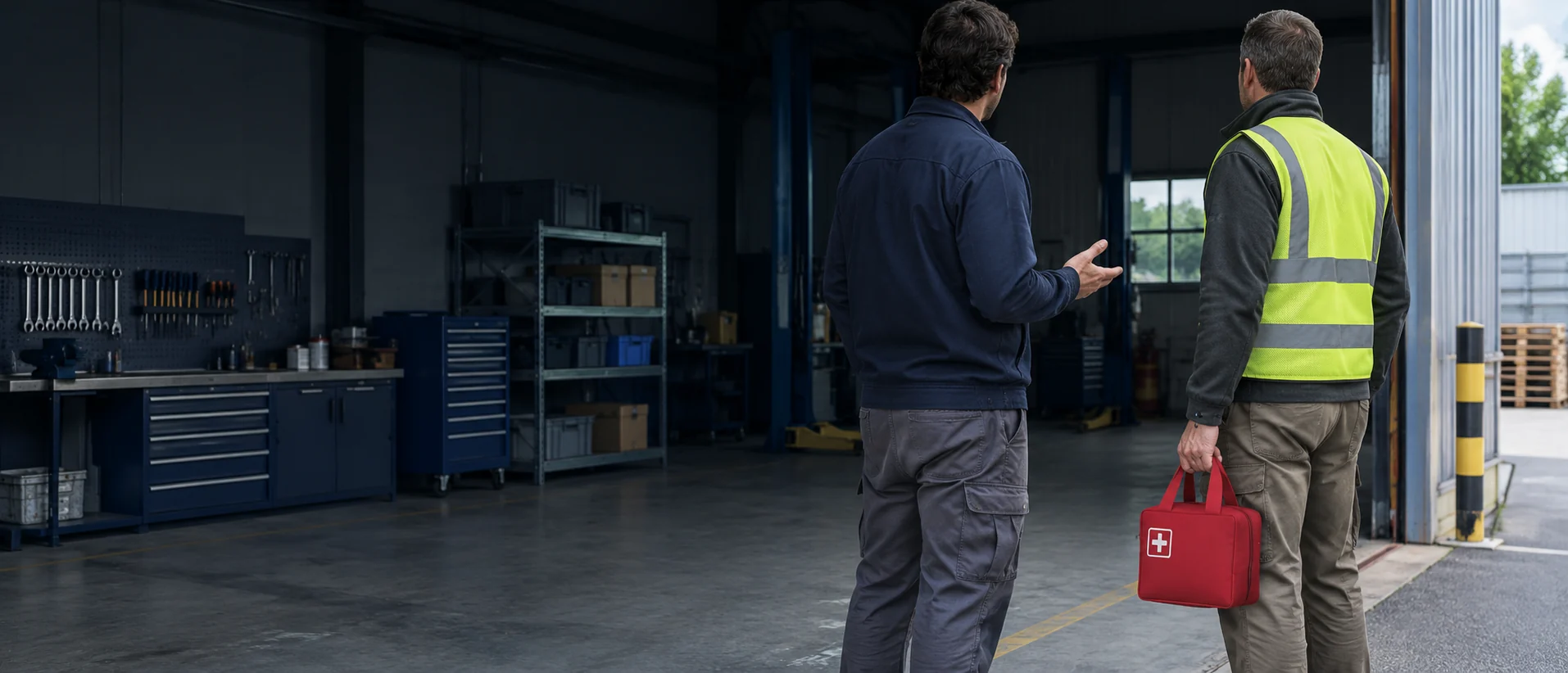
Choose a first aid kit around the work people do, where they work and how help will reach them. A construction crew, delivery driver, school coach and remote field team can need different access arrangements even when some of their basic supplies overlap.
For distributors, safety-equipment importers and OEM buyers, that makes the purchasing brief more important than a headline piece count. The right question is not simply “How many items are inside?” It is “Will the agreed supplies be accessible, identifiable and maintained in this particular setting?”
This guide connects different professions and work scenarios to practical kit selection. It explains the questions to ask about placement, container format, contents, documentation and replenishment, with references to official guidance and published research. It supports purchasing and planning; clinical equipment and treatment decisions belong with appropriately qualified people and the applicable local requirements.
01 / START WITH THE WORK
What Makes a First Aid Kit Suitable for a Particular Industry?
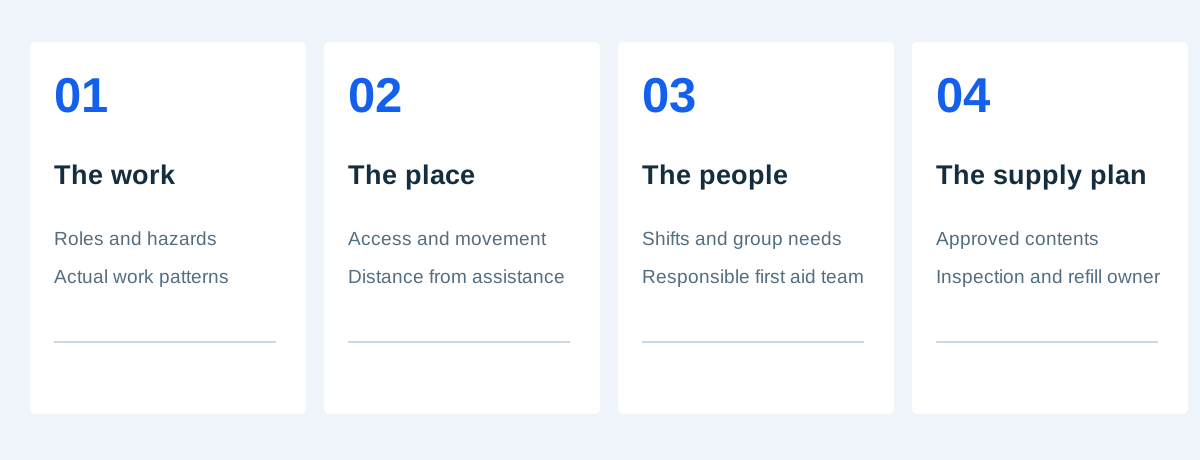
A job title is a useful starting point, but it does not describe the whole requirement. Two electricians may work in very different conditions: one in a staffed workshop, the other travelling between isolated sites. Their kit decisions should reflect that difference in location, communication and access to assistance.
HSE's Great Britain guidance asks employers to assess the work, hazards, workforce, working patterns and accident history. It also identifies travelling, remote and lone workers as factors to consider. US OSHA guidance similarly describes reviewing workplace needs and adjusting supplies as those needs change.[1][2]
Turn that assessment into an operational picture before selecting a container. Record who is present on each shift, where they move during the day, which areas are separated by doors or floors, and who will inspect and replenish the supplies. These details explain why one central kit may be convenient in an office yet insufficient for a dispersed work team.
| Profession or team | Typical setting to assess | Purchasing question that changes the specification |
|---|---|---|
| Construction workers and maintenance trades | Changing work fronts, temporary compounds, outdoor jobs | Can supplies move with the crew while remaining protected and accessible? |
| Manufacturing and warehouse staff | Production cells, loading areas, separate shifts | Can each operating area reach its assigned kit without an avoidable delay? |
| Delivery drivers and mobile technicians | Vehicles, customer sites, roadside stops | Does the kit travel with the worker and have a secure, known storage position? |
| Chefs, catering and hotel teams | Kitchens, housekeeping areas, public premises | How will the kit fit the site's hygiene, cleaning and staff-access arrangements? |
| Teachers and sports coaches | Classrooms, pitches, excursions | What provision stays at the premises and what accompanies the group? |
| Office and retail managers | Multiple floors, reception, stockrooms | Does the access plan cover employees, visitors and all opening hours? |
| Outdoor guides, farmers and landscaping crews | Trails, fields and changing remote locations | How do communication, weather exposure and travel time affect the plan? |
This table is a purchasing framework, not a prescribed packing list or a statement that every workplace in a sector has identical risks.
The scale of workplace incidents gives useful context. The US Bureau of Labor Statistics reported 2.5 million nonfatal injuries and illnesses in private industry in 2024, with a total recordable rate of 2.3 cases per 100 full-time-equivalent workers. These figures cover a broad range of cases; they do not measure how many incidents a first aid kit can treat or prevent.[9]
Use local incident records and the site's needs assessment to make the specification specific. National statistics explain the importance of planning; they cannot determine the contents of an individual workplace kit.
02 / CONSTRUCTION AND INDUSTRIAL TEAMS
First Aid Kits for Construction Workers, Manufacturers and Warehouses
Construction sites and mobile trades
A construction site can change its access routes and working areas as a project progresses. A kit left in a site office may be easy to find during induction and less useful when a small crew moves to another work front. Discuss both fixed storage and a portable option with the person responsible for the site's first aid arrangements.
There is also a concrete jurisdiction-specific requirement to check. For US construction work within its scope, OSHA 1926.50(d)(2) calls for a weatherproof container, individually sealed packages for each type of item, and contents checks before dispatch to each job and at least weekly on each job. This is a US construction provision, not a universal inspection timetable for every industry or country.[3]
Translate the applicable requirement into sample checks: inspect closure operation, internal organisation and how the packed kit will be carried. If environmental protection is specified, obtain evidence for the complete selected container. A fabric description, zipper flap or product photograph does not establish a weatherproof rating.
Manufacturing, workshops and warehouses
For an industrial site, begin with the layout. A receiving area, production line and maintenance room can have different access routes and work schedules. Ask supervisors to identify actual storage points, including what happens during a night shift, a locked-office period or work at a remote loading bay.
Where corrosive exposure is identified, separate the kit discussion from the need for suitable emergency washing facilities. US OSHA 1910.151(c) addresses quick drenching or flushing facilities where eyes or the body may be exposed to injurious corrosive materials. Purchasing a portable bag does not establish that those facilities are adequate.[4]
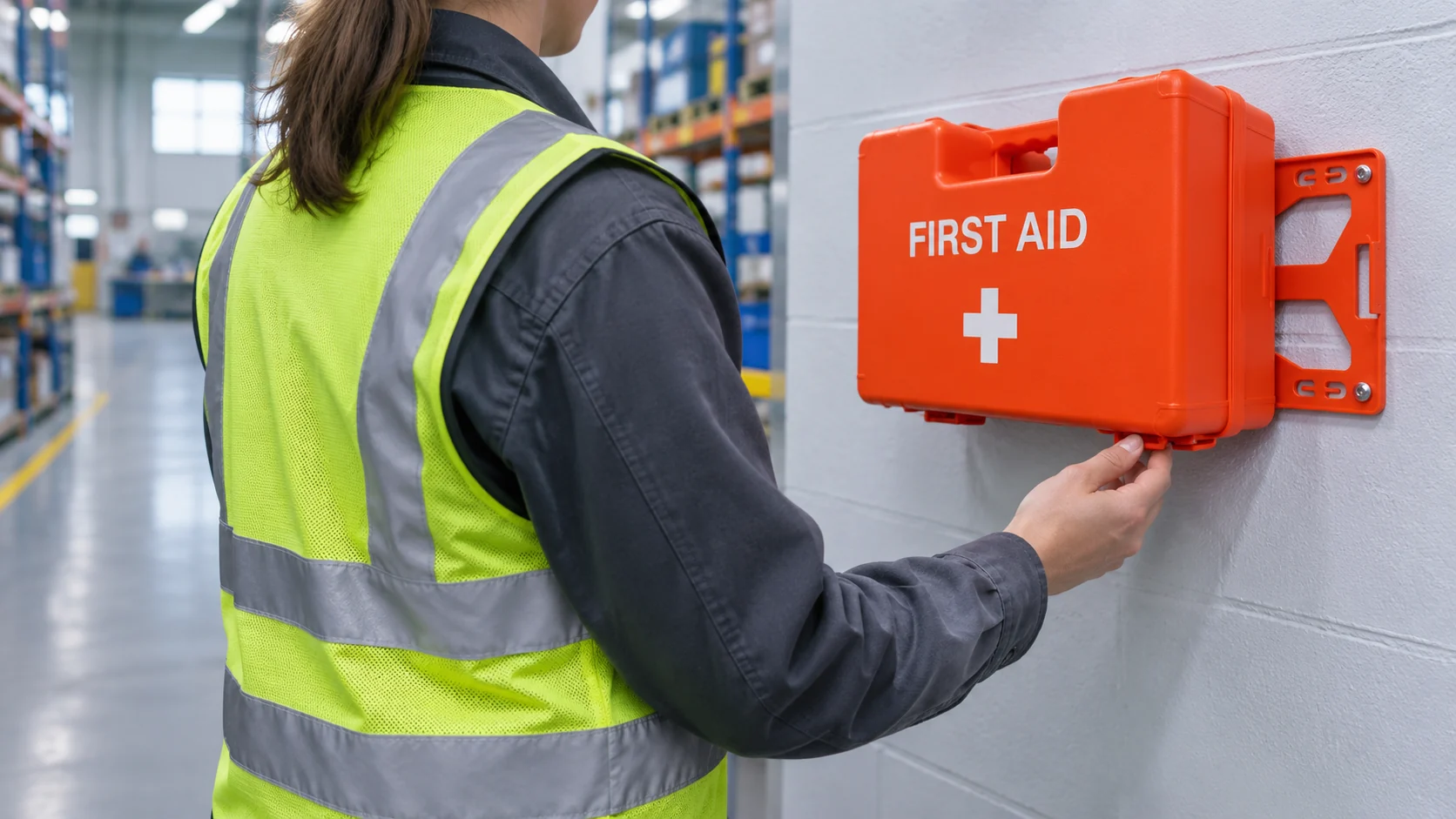
A wall location and a grab-and-go container can serve different parts of the plan. The FA-024 ABS Wall-Mount First Aid Case is an existing container reference for a designated workplace point. The FA-001 Handled Outdoor First Aid Bag provides a handled format to review for carrying. Approve the contents and any environmental requirements separately; neither format alone establishes workplace compliance.
Scenario to review: a maintenance team leaves the main building to service equipment in an outlying area. Confirm which kit accompanies the team, who carries it, and how the team contacts help. That conversation is more useful than choosing a larger kit solely because the facility employs more people.