
4. Try the jacket with the equipment that changes its fit
Movement is where a technical shell separates itself from a garment that only looks appropriate on a hanger. KAILAS's MONT Q60 description refers to patterning developed around climbing motions. The selected Alpha SV page identifies articulated patterning, a helmet-compatible hood and chest storage compatible with a harness. These are brand-published design features; their value to a particular buyer still needs a fit trial. [2][3]
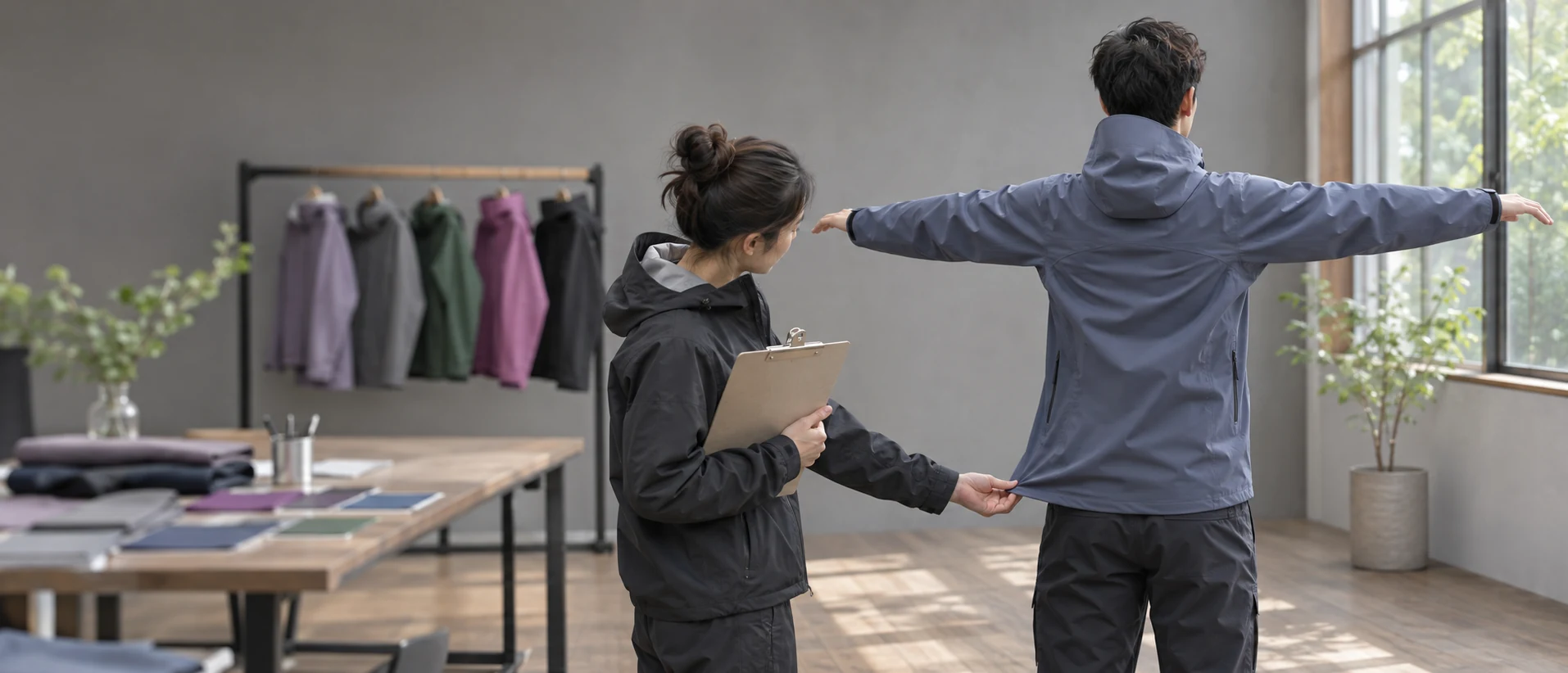
Test the sample with the intended base and midlayers. Have the wearer reach overhead, bring both hands forward, bend, lift a knee and turn the head. Observe whether the hem rises excessively, the shoulders bind or the sleeves pull back. Document what happens rather than recording only that the jacket feels “comfortable.”
Then add the actual backpack and, where relevant, helmet or harness. Close the hip belt. Check which pockets remain accessible, whether the hood follows the head and whether the wearer can see to the side. Evaluate drawcords and zipper pulls with the gloves specified for the program. Confirm that adjustment does not leave loose cords where the equipment makes them troublesome.
A fit defect should lead to a specific revision: sleeve shape, body ease, pocket position or adjustment range. Merely increasing the size can introduce new problems elsewhere. Review more than one garment size and more than one relevant wearer before approving grading.
| Interface | Sample task | Useful observation |
|---|---|---|
| Shell and layers | Reach and bend in intended underlayers | Binding, unwanted compression and hem movement |
| Hood and headwear | Turn and look upward after adjustment | Coverage, visibility and hood stability |
| Pockets and carried equipment | Retrieve the intended objects with straps fastened | Access, capacity and closure operation |
| Cuffs and gloves | Adjust sleeves during normal movement | Grip, closure range and coverage |
5. Judge comfort as a clothing system
A buyer should ask how the wearer manages changing effort. The selected Beta AR page includes pit zippers for ventilation. That is a different function from moisture transport through the material, and both need consideration when assessing a complete shell. [1]
Laboratory breathability results remain useful when their conditions are understood. ISO 11092:2026 measures thermal and water-vapor resistance under steady-state conditions; its public scope says the conditions are not intended to represent a specific comfort situation. This edition was published in May 2026 and replaced the 2014 edition. Keep the edition on each report rather than silently treating old and new records as identical. [6]
In a wear trial, record pace, underlayers, temperature, precipitation, carried load and when openings were adjusted. Compare the same use sequence between candidates where practical. A slower, cooler walk in one jacket and a steep ascent in another cannot establish which garment manages moisture better.
Pay attention to transitions. Can the wearer open ventilation before overheating? Is the shell easy to remove and stow? Does an insulating layer fit underneath when stopping? Would the intended customer actually use the adjustment system, or is it too difficult to operate with wet gloves?
Avoid treating dampness inside as a complete diagnosis. Record location, timing and conditions, then assess possible entry points and internal moisture separately. The MVTR and RET guide explains why unlike breathability figures need careful comparison. A useful buying decision combines appropriate reports with repeatable observations of the dressed, equipped wearer.
6. Make the weight and durability tradeoff explicit
Lightness only becomes meaningful when the product's job remains intact. Compare candidate weights using the same garment size and a stated configuration. Confirm whether removable parts are included. Measure packed volume using a repeatable approach rather than judging how small a sample can be compressed for a photograph.
The Beta AR's mapped construction and the MONT Q60's published heavier-duty fabric direction illustrate different ways of presenting material priorities. They are not evidence that either approach is universally better. The buyer's task is to identify where extra material supports the activity and where it creates an unnecessary burden. [1][3]
For a shell worn under a loaded pack, examine contact areas and the proposed durability evidence. For a layer carried most of the day, evaluate stowing and handling alongside the level of protection required. Do not assume that all customers will exchange durability for a lower number on the hangtag.
Ask what a proposed weight reduction removes. Is it a pocket, fabric mass, seam protection, adjustment range or an interior surface? Request the revised sample and repeat the checks affected by the change. The price and mass may improve while an essential function deteriorates.
Use a decision record with three columns: intended benefit, possible loss and evidence needed. This makes the tradeoff reviewable. It also prevents a development team from gradually stripping out necessary functions through several small changes that each appear harmless in isolation. There is no universal ideal shell weight independent of fit, construction and use.