

Introduction: Why Breathability Ratings Matter When Sourcing Waterproof Jackets
When sourcing waterproof outdoor jackets, breathability is one of the most important performance indicators buyers need to evaluate. A jacket may offer excellent protection against rain, wind and external moisture, but if water vapour cannot escape efficiently, the wearer may experience excessive heat, internal condensation and discomfort during physical activity.
For outdoor apparel brands, this creates a significant product development challenge: how can you select a fabric that provides reliable waterproof protection while maintaining sufficient moisture transfer under different environmental and activity conditions?
Two measurements frequently appear in technical data sheets and supplier quotations:
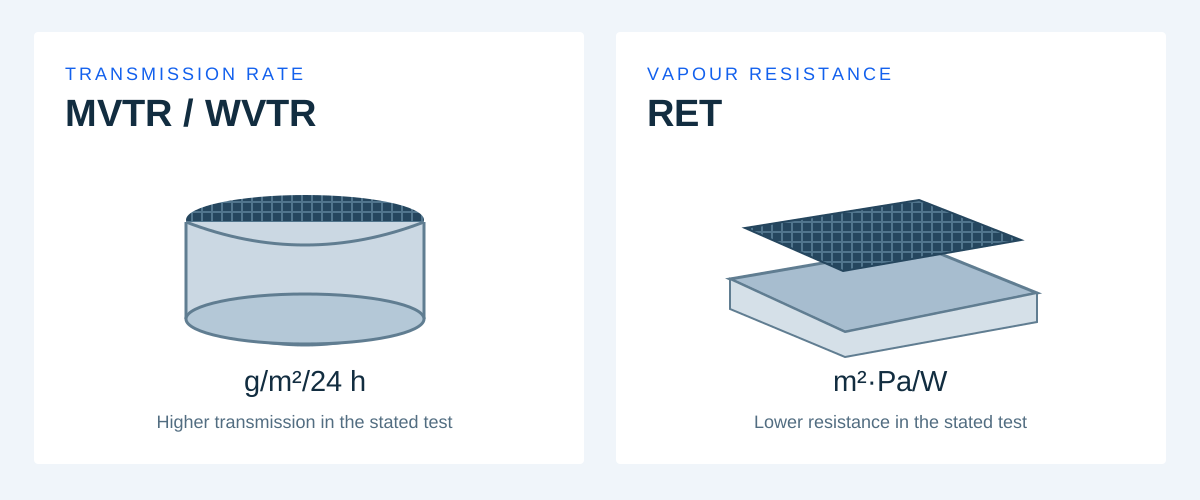
- MVTR (Moisture Vapour Transmission Rate): Measures the amount of water vapour passing through a material over a specified period.
- RET (Resistance to Evaporative Heat Transfer): Measures the resistance a material offers to water vapour transfer under controlled laboratory conditions.
Both measurements provide useful information, but they are not interchangeable. A fabric with a high MVTR result is not automatically equivalent to a fabric with a low RET result.
For purchasing teams, understanding this distinction is essential when comparing fabric suppliers, approving samples, developing product specifications and establishing quality control standards.
This guide explains the technical differences between MVTR and RET, the testing procedures behind these measurements, and how to use them to make better sourcing decisions for waterproof outdoor jackets.
01 / UNDERSTAND THE METRICS
What Do MVTR and RET Actually Measure in a Waterproof Jacket?
Breathability refers to a textile's ability to transfer moisture vapour from the inside of a garment to the external environment.
During physical activity, the human body produces heat and perspiration. Some perspiration evaporates into water vapour, which needs to move through the garment to maintain a comfortable microclimate.
Waterproof breathable fabrics are designed to manage two competing requirements:
- Prevent external liquid water from penetrating the fabric.
- Allow internal water vapour to escape through the material.
These functions are related but technically different. Waterproofness and breathability should therefore be tested and specified separately.
1. MVTR: Moisture Vapour Transmission Rate
MVTR measures how much water vapour passes through a defined area of fabric within a specified period.
It is commonly expressed as:
g/m²/24h
For example, a fabric with an MVTR result of 15,000 g/m²/24h has transmitted 15,000 grams of water vapour per square metre over 24 hours under the specified test conditions.
In general:
- Higher MVTR indicates greater measured water vapour transmission.
- Lower MVTR indicates less measured water vapour transmission.
However, MVTR is highly dependent on the test method and environmental conditions.
Important variables include:
- Temperature and relative humidity.
- Water vapour pressure difference across the specimen.
- Upright cup or inverted cup configuration.
- Desiccant or water-based test procedure.
- Specimen thickness and construction.
- Test duration and specimen conditioning.
A supplier reporting 20,000 g/m²/24h without identifying the test method has not provided enough information for a meaningful technical comparison.[7]
2. RET: Resistance to Evaporative Heat Transfer
RET measures the resistance of a textile to water vapour transfer.
It is commonly determined using the sweating guarded-hotplate method, also known as the skin model.
The measurement is generally expressed as:
m²·Pa/W
Unlike MVTR, RET is a resistance measurement.
The interpretation is therefore reversed:
- Lower RET indicates lower resistance to water vapour transfer.
- Higher RET indicates greater resistance to water vapour transfer.
A lower RET value generally indicates better evaporative transfer performance under the specified laboratory conditions.
The sweating guarded-hotplate method simulates certain heat and moisture transfer processes occurring near human skin. It can evaluate individual fabrics, coatings, films and multilayer textile assemblies.
3. MVTR vs RET: Key Differences
| Technical factor | MVTR | RET |
|---|---|---|
| Full name | Moisture Vapour Transmission Rate | Resistance to Evaporative Heat Transfer |
| Measurement | Water vapour transmission | Resistance to vapour transfer |
| Common unit | g/m²/24h | m²·Pa/W |
| Preferred direction | Higher | Lower |
| Typical method | Cup method | Sweating guarded-hotplate |
| Main application | Fabric development and quality control | Thermal and physiological comfort evaluation |
| Purchasing consideration | Verify test conditions | Verify test standard and specimen construction |
Important purchasing note: There is no universal mathematical conversion between MVTR and RET.
Do not use a simple conversion formula to compare supplier quotations. A valid comparison requires consistent testing procedures, environmental conditions and specimen configurations.
4. Understanding the Standards Behind the Numbers
Professional buyers should pay attention not only to the reported result but also to the standard used.
Three particularly relevant references are:
- ISO 11092:2026: Current international edition for measuring thermal and water-vapour resistance under steady-state conditions using the sweating guarded-hotplate method.
- ISO 15496:2018: A comparatively simple textile water-vapour permeability measurement method designed for quality control.
- ASTM E96/E96M: Gravimetric methods for determining water vapour transmission through materials, including desiccant and water methods.
These standards have different purposes and should not be treated as interchangeable.
For example, ISO 15496 is useful for routine factory quality control, but it is not a substitute for ISO 11092 when evaluating water-vapour resistance against physiological performance requirements.
For buyers sourcing technical outdoor fabrics, the standard and its edition should always be recorded in the purchase specification.[1],[2],[3]