
05 / BUYER CHECKLIST
How to Evaluate Waterproof Breathable Fabric Suppliers Before Placing an Order
For purchasing managers, the goal is not simply to find a fabric with the highest breathability rating.
The goal is to find a reliable material that meets the target product's performance requirements, production budget and long-term quality expectations.
The following checklist can be used during supplier evaluation.
1. Request a Complete Technical Data Sheet
Before requesting a quotation, ask the supplier to provide:
- Fabric composition.
- Fabric construction.
- Fabric weight in g/m².
- Total thickness.
- Waterproof membrane or coating type.
- MVTR result and test method.
- RET result and test method, if available.
- Hydrostatic head result.
- DWR performance.
- Available colours.
- Available widths.
- Minimum order quantity.
- Production lead time.
A supplier that provides only a breathability figure without supporting technical information should be asked to submit additional documentation.
2. Verify Waterproofness Separately
Breathability and waterproofness are different performance characteristics.
For waterproof jacket development, buyers should also request hydrostatic head testing.
Hydrostatic head measures the resistance of a material to water penetration under increasing water pressure.[10]
It is commonly expressed in:
mmH₂O
For example, a result of 10,000 mmH₂O indicates the pressure level recorded under the specified test procedure.
However, the required waterproofness level depends on the intended application, product standard and construction.
A lightweight urban rain jacket and a mountaineering shell may require different performance specifications.
For demanding products, also evaluate seam leakage, zipper protection and the finished garment's resistance to water penetration.
3. Compare Suppliers Using the Same Technical Requirements
A practical supplier comparison should include more than unit price.
| Evaluation category | Supplier A | Supplier B | Supplier C |
|---|---|---|---|
| Fabric weight | To be confirmed | To be confirmed | To be confirmed |
| MVTR | To be confirmed | To be confirmed | To be confirmed |
| MVTR test method | To be confirmed | To be confirmed | To be confirmed |
| RET | To be confirmed | To be confirmed | To be confirmed |
| Hydrostatic head | To be confirmed | To be confirmed | To be confirmed |
| DWR durability | To be confirmed | To be confirmed | To be confirmed |
| Washing performance | To be confirmed | To be confirmed | To be confirmed |
| MOQ | To be quoted | To be quoted | To be quoted |
| Lead time | To be quoted | To be quoted | To be quoted |
| Price | To be quoted | To be quoted | To be quoted |
This format makes it easier to identify suppliers that offer the best overall technical and commercial value.
4. Evaluate Total Purchasing Cost, Not Just Fabric Price
The lowest fabric price does not necessarily result in the lowest total product cost.
Consider the following factors:
- Fabric cost per metre.
- Fabric consumption per garment.
- Cutting waste.
- Lamination and bonding costs.
- Seam tape requirements.
- Additional finishing treatments.
- Testing and certification expenses.
- Rework and rejection risks.
- Production yield.
For example, a slightly more expensive three-layer fabric may reduce the need for additional lining materials and simplify certain construction requirements.
The correct comparison should therefore consider the complete garment specification and production process.
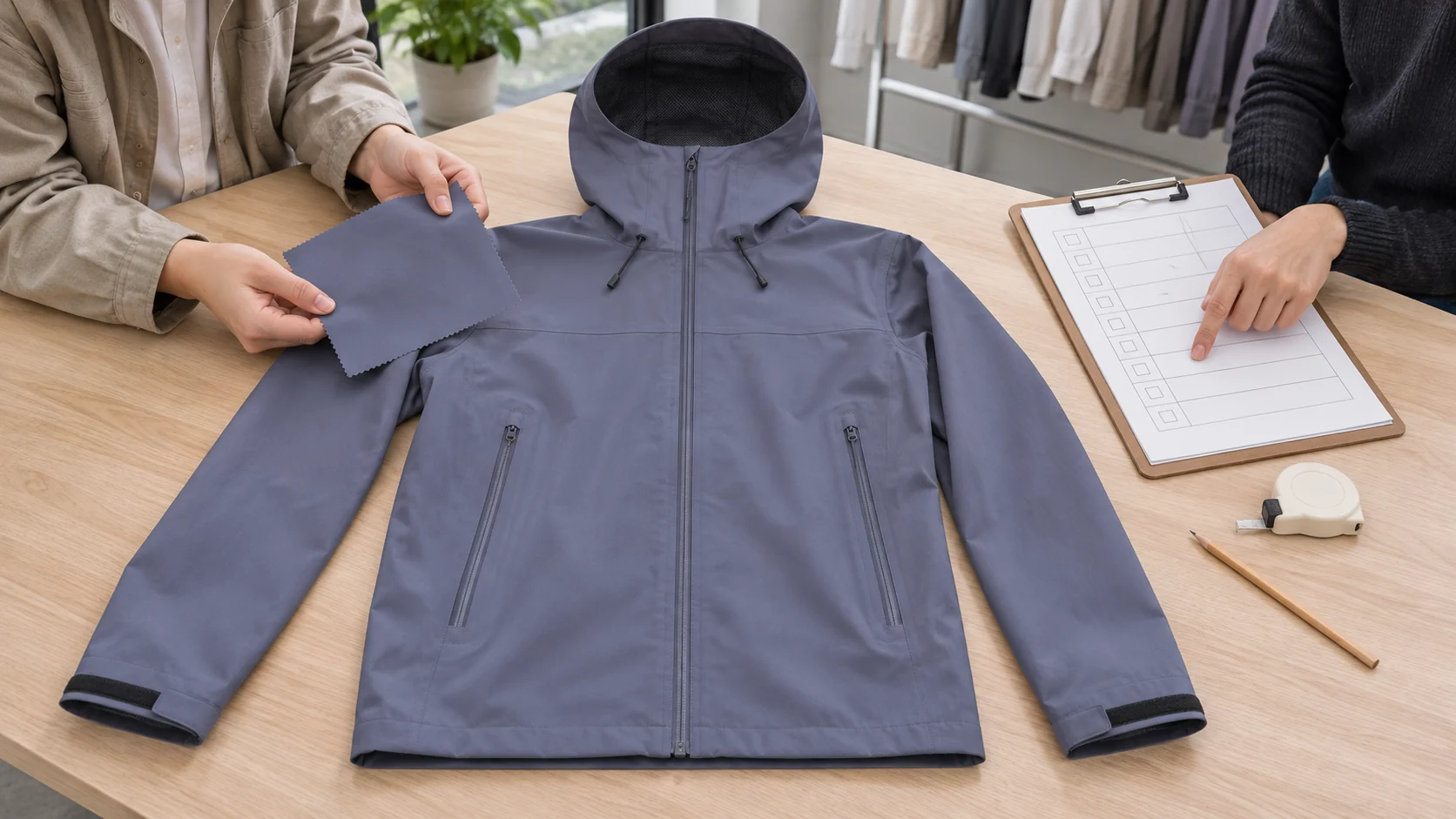
5. Conduct Pre-Production Sample Approval
Before bulk production, establish a clear approval process.
Recommended procedure:
- Receive supplier technical data sheets.
- Review and verify the laboratory reports.
- Select the fabric construction.
- Request physical fabric samples.
- Conduct independent testing when necessary.
- Develop the prototype garment.
- Evaluate waterproofness, breathability and construction.
- Approve the pre-production sample.
- Establish bulk production inspection criteria.
The approved sample should become the physical and technical reference for subsequent production batches.
6. Establish Bulk Production Quality Control
A common sourcing mistake is to approve one development sample and assume that all subsequent production will have identical performance.
For repeat orders, buyers should define:
- Incoming fabric inspection requirements.
- Batch identification and traceability.
- Agreed testing frequency.
- Acceptable performance tolerances.
- Colour consistency requirements.
- Weight and width tolerances.
- Defect classification.
- Corrective action procedures.
For critical waterproof breathable materials, periodic independent laboratory verification can help reduce the risk of performance deviations.
7. Questions Every Buyer Should Ask a Fabric Supplier
Before confirming a purchase order, consider asking:
- Which test standard was used to obtain the MVTR result?
- Can you provide the original laboratory report?
- Is the reported RET value based on ISO 11092?
- Can you provide waterproofness test results?
- Has the fabric been tested after repeated washing?
- What membrane or coating technology is used?
- Can the same performance be maintained across bulk production batches?
- What is your MOQ for custom colours and specifications?
- Can you provide fabric samples for independent testing?
- Can your team support custom fabric development for our jacket collection?
These questions help buyers distinguish between a supplier that simply sells fabric and a manufacturing partner capable of supporting a complete product development program.