
04 / FABRIC TO GARMENT
Why Does Fabric Breathability Not Always Reflect Finished Jacket Performance?
This is one of the most important distinctions in technical outdoor apparel sourcing.
A fabric laboratory report does not automatically predict the comfort performance of a finished jacket.[6]
A jacket is a complete system consisting of multiple materials, components and construction details.
Even when the main fabric has a low RET value or high MVTR rating, other garment components can restrict moisture transfer.
1. Two-Layer, 2.5-Layer and Three-Layer Construction
Different fabric constructions offer different combinations of durability, weight, comfort and moisture management.
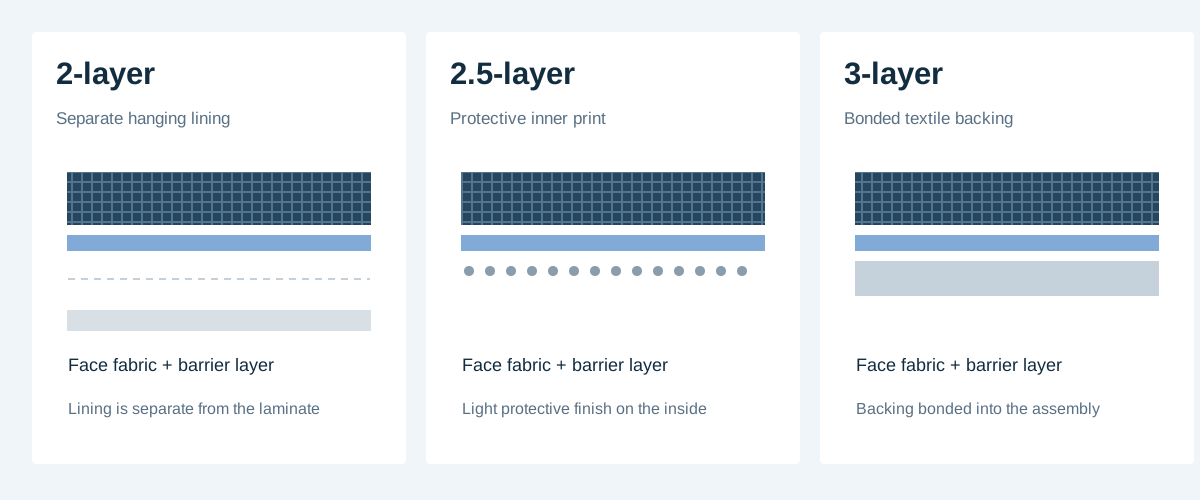
Two-Layer Construction
Usually consists of an outer face fabric laminated or coated with a waterproof breathable membrane.
A separate lining is generally used to protect the membrane and improve wearing comfort.
Typical applications:
- Everyday rain jackets.
- Urban outdoor clothing.
- General-purpose hiking jackets.
2.5-Layer Construction
Combines a face fabric, waterproof breathable membrane and a lightweight protective print or coating on the inside.
Typical advantages:
- Lightweight construction.
- Compact packing.
- Reduced garment weight.
Typical applications:
- Lightweight hiking jackets.
- Packable rainwear.
- Travel outdoor apparel.
Three-Layer Construction
Combines the outer face fabric, waterproof breathable membrane and inner backing into one laminated assembly.
Typical advantages:
- Greater structural stability.
- Improved internal protection of the membrane.
- Suitability for demanding outdoor applications.
Typical applications:
- Technical hiking jackets.
- Mountaineering shells.
- Professional outdoor workwear.
The best construction depends on the intended end use, not simply the highest breathability number.[9],[14]
2. Face Fabric and Membrane Compatibility
The face fabric and membrane must work together.
Important variables include:
- Face fabric fibre composition.
- Fabric weight and thickness.
- Weave or knit construction.
- Membrane material and thickness.
- Coating or lamination technology.
- Adhesive distribution.
- Inner backing construction.
For example, two fabrics may use similar membrane technology but produce different results because of differences in face fabric construction or lamination.
Buyers should therefore evaluate the complete laminated fabric rather than selecting a membrane based solely on its advertised technical performance.
3. DWR: Durable Water Repellent Treatment
Durable Water Repellent treatment helps water form droplets and roll off the fabric surface.
It is generally applied to the outer face fabric.
DWR is not the same as waterproofing.
A waterproof membrane or coating provides the primary barrier against liquid water penetration, while DWR helps prevent the outer fabric from becoming saturated.
When the face fabric becomes saturated, the jacket may feel heavier and less comfortable. Moisture transfer can also become less effective in practical use.[11]
Purchasing teams should evaluate:
- Initial spray rating.
- Spray performance after washing.
- Spray performance after abrasion.
- Compatibility with the membrane.
- Applicable chemical compliance requirements.
Do not assume that a high MVTR result guarantees good DWR performance.
4. Seams, Zippers and Ventilation
The finished jacket contains areas that are not represented by a flat fabric specimen.
These include:
- Taped seams.
- Waterproof zippers.
- Pocket constructions.
- Underarm panels.
- Cuffs and hems.
- Hood adjustments.
- Ventilation openings.
Seam tape can introduce additional layers and alter the local construction.
Zippers and pocket structures may create areas where moisture and heat accumulate.
For active-use jackets, ventilation features such as underarm zippers may improve comfort by providing an additional route for heat and moisture release.
This means a jacket with a slightly lower fabric MVTR may still perform better in practical use if its overall construction is more effectively designed.
5. Fabric Testing vs Finished Garment Testing
| Evaluation item | Fabric-level testing | Garment-level testing |
|---|---|---|
| MVTR | Suitable | Not the main method |
| RET | Suitable | Can be evaluated on assemblies using appropriate methods |
| Hydrostatic head | Suitable | Additional garment construction checks needed |
| Seam leakage | Not fully represented | Essential |
| DWR | Face fabric evaluation | Practical use and care evaluation |
| Fit and ventilation | Not represented | Essential |
| Wearing comfort | Limited indication | More representative |
OEM purchasing insight: Always distinguish between fabric performance approval and finished garment performance approval. Both are necessary for technically demanding waterproof jacket programs.