
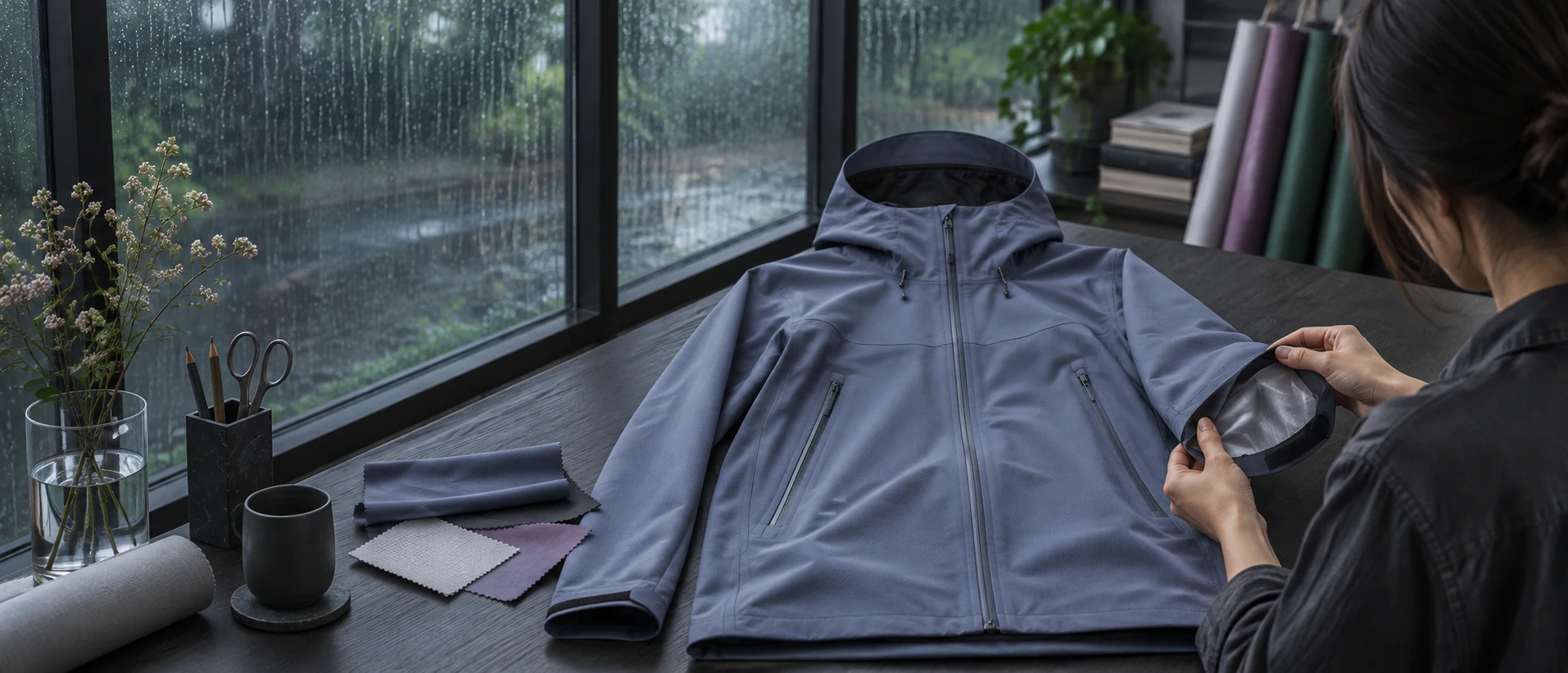
Nylon and polyester can both form the outer face of a waterproof jacket. Neither fiber name tells a buyer how much water pressure the finished fabric will withstand. That depends on the complete construction: the face textile, waterproof membrane or coating, surface finish, backing and garment assembly. A useful material comparison therefore starts with the laminate specification and test report, then asks how performance changes through washing and wear.
For brands choosing a waterproof jacket fabric, the practical question is which combination will meet the intended use at an acceptable weight, hand feel, durability and cost. This guide separates the material choices, examines published experiments and turns their findings into a sample approval brief.
1. Waterproof jacket fabric is a system of different jobs
The face fabric is the textile you see and touch. A membrane or coating provides the principal liquid-water barrier in many technical shells. A durable water-repellent finish, usually shortened to DWR, changes how water behaves on the outer surface. An inner textile or protective treatment shields the barrier and affects the feel of the garment. These descriptions belong on separate lines of a specification sheet.
The distinction becomes clearer when looking at the tests. ISO 811:2018 concerns resistance to water penetration under hydrostatic pressure. ISO 4920:2012 concerns resistance to surface wetting and explicitly does not measure penetration through the fabric. A fabric can perform well in a spray test while remaining unsuitable for a jacket whose intended use requires a pressure-resistant barrier. [1][2]
| Component | Question it helps answer | Evidence to request |
|---|---|---|
| Face textile | What textile is exposed to rubbing, rain and handling? | Fiber composition, yarn specification, weave, mass and physical tests |
| Membrane or coating | What is the liquid-water barrier? | Polymer, construction and hydrostatic test report |
| DWR finish | How readily does the face wet out? | Finish identification and spray results before and after care |
| Backing or protective treatment | What protects the inside of the barrier? | Construction description and approved hand-feel sample |
| Seams and openings | Where can water bypass the fabric? | Seam specification and garment-level evaluation |
Treat this as a document structure for comparing quotations. If one supplier quotes a face fabric and another quotes a complete laminate, the two prices and performance descriptions are incomplete until their scope is aligned.
2. Nylon vs polyester: compare the actual textile
Nylon is a polyamide; polyester shell textiles commonly use PET. Their polymer chemistry differs, including their interaction with moisture. NIST-hosted supporting information on textile fibers distinguishes water absorbed into fibers from water transported along their surfaces and explains that synthetic-fiber uptake can also be affected by processing. Those material-level descriptions do not establish the waterproof rating of a jacket laminate. [3]
In sourcing, avoid turning a general fiber characteristic into a finished-product promise. A nylon swatch and a polyester swatch may also differ in yarn size, weave density, fabric mass, finishing and backing. If all those factors change at once, a difference in tear strength, wet feel or hydrostatic resistance cannot be attributed to the fiber alone.
Request matched alternatives when the development question is genuinely about nylon versus polyester. Ask the mill to identify which specifications remain the same and which must change. Examine actual swatches in the proposed colors, then compare the reports for the finished constructions. Include both dry handling and a repeatable wetting-and-drying assessment when wet bulk or drying behavior matters to the range.
Denier is a yarn linear-density description, not a waterproof rating. Use it to identify the proposed yarn, alongside weave and mass, rather than as a substitute for testing. Similarly, a recycled-content designation should have its own traceability evidence; it does not supply the missing waterproof or durability results.
| Comparison | Useful purchasing question | Decision to avoid |
|---|---|---|
| Nylon versus polyester | Are these alternatives built and tested comparably? | Declaring one fiber universally more waterproof |
| Different yarn sizes | What changes in mass, handle and physical performance? | Treating denier as hydrostatic head |
| Conventional versus recycled feedstock | Is the actual laminate approved, with the required documentation? | Assuming feedstock label proves equal performance |
3. What a twelve-fabric experiment actually showed
Hyun-Ah Kim's study in Coatings compared twelve commercially sourced coated, laminated and high-density fabrics. In that sample set, a finished high-density nylon fabric recorded a water-repellency rating reported as 100% in that study, but hydrostatic resistance below 1,000 mm H₂O. Several laminated specimens exceeded 6,000 mm H₂O. These are findings for those particular constructions, measured using the study's procedures. [4]
This is a useful demonstration of why visible beading and pressure resistance need separate evidence. It is also a limited comparison: the specimens differed in construction, density and finishing. It does not establish a universal advantage for nylon, a minimum rating for every laminate, or a ceiling for every coating. The authors' layer terminology should likewise be read in the context of their specimen descriptions rather than used to rename a supplier's construction.
For a buyer reviewing two quotations, the implication is to ask for the report that corresponds to each submitted swatch. A picture of water beading on one material cannot resolve a missing hydrostatic result for the other. Nor can a published result for a research specimen establish the performance of a Wisp jacket.