
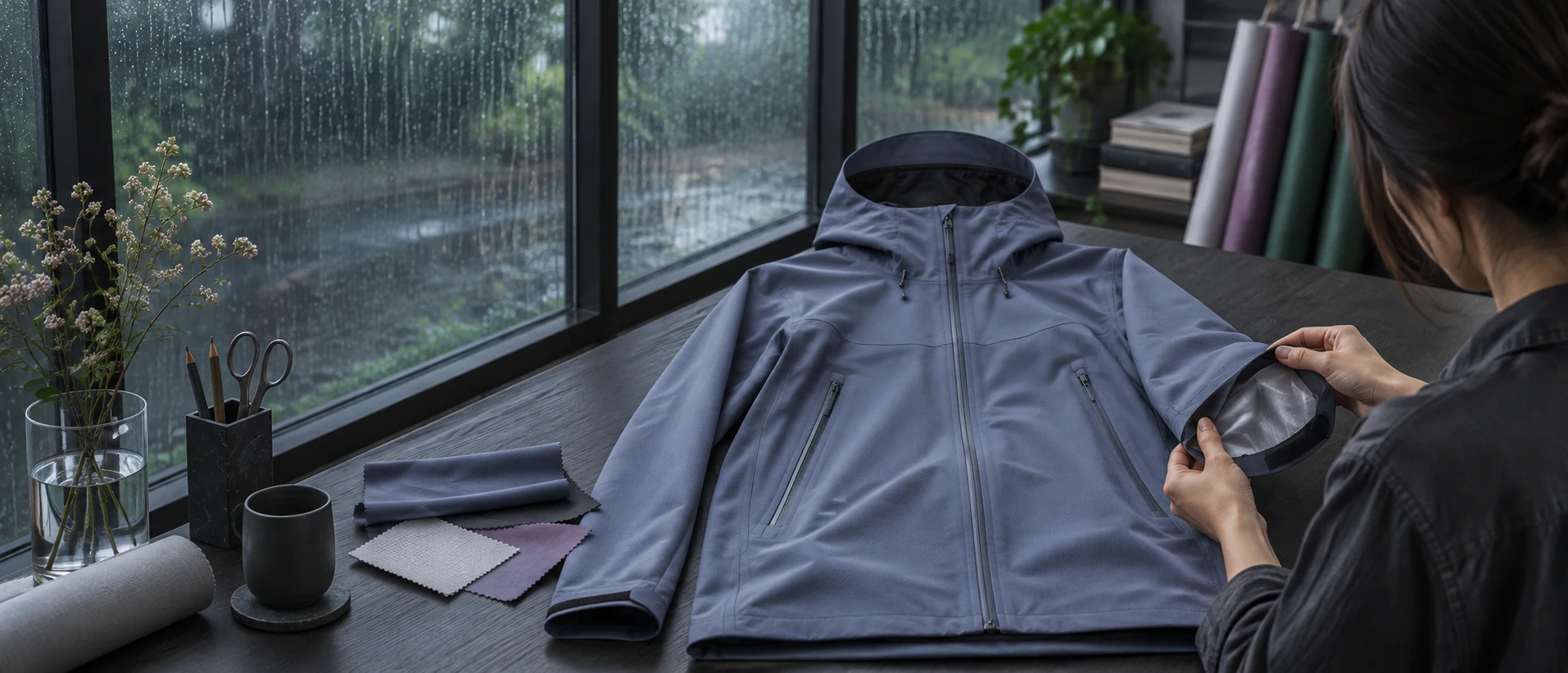
4. Membranes and coatings: identify the barrier mechanism
Chang and Liu's 2023 review distinguishes hydrophobic microporous membranes from hydrophilic nonporous membranes. Microporous structures provide interconnected pathways for vapor while resisting liquid-water entry through their pore structure and wettability. Nonporous hydrophilic films transport moisture through sorption and diffusion in the polymer. A nonporous film can therefore transmit water vapor without ventilation holes. [5]
The polymer name alone is insufficient. Polyurethane can be used in different constructions, and the words PU or TPU do not specify the pore structure, thickness or complete laminate. A coating is applied onto a substrate; a laminate bonds a separately formed barrier to another layer. Both descriptions still require information about the resulting material.
Ask for a cross-section or a clear layer diagram and a bill of materials. Then obtain waterproof and breathability reports for that assembly. If a supplier offers a higher hydrostatic result by changing the barrier, have the new sample checked for the other properties that matter to the program. Performance targets should be approved together.
For breathability, ISO 11092:2026 specifies steady-state thermal and water-vapor resistance measurements; its public scope also says the conditions do not represent a particular comfort situation. Published in May 2026, this edition replaces ISO 11092:2014. Retain the exact edition when reviewing an existing report, and read our MVTR vs RET guide before comparing different methods. [6]
5. Two, two-and-a-half and three layers need a construction drawing
In common shell terminology, a two-layer laminate bonds the outer textile to a barrier, while a three-layer laminate also bonds an inner textile into the assembly. Gore's own construction descriptions illustrate this distinction. Two-and-a-half-layer designs generally use a thin protective treatment instead of a conventional full textile backer, but the exact treatment needs to be identified for the material being offered. Layer counts describe construction rather than providing an independent performance grade. [7][8]
That makes the supplier drawing more useful than the category name. Ask whether a quoted jacket has a separate lining, a bonded backer, a printed protective surface or another arrangement. Confirm whether the quoted mass refers to the laminate or the finished garment. Make sure the lining shown in the sample is included in the production quotation.
For a compact travel shell, buyers may prioritize packed volume and handling. For a frequently worn hiking shell, buyers may place more emphasis on the inside surface, repair options and repeated-care performance. These are development priorities to test against samples. They are not guarantees attached to a layer count.
A practical shortlist can start with Wisp's hardshell jacket range. Compare the construction evidence for the specific proposed style before assigning it to a lightweight or sustained-use collection.
6. DWR, wet-out and fluorine-free alternatives
DWR helps keep the face textile from saturating. Gore's care guidance explains that when its outer textile wets out, the underlying waterproof membrane may still function, while the garment feels cold or clammy. The guidance concerns Gore products, but it clearly illustrates why loss of beading and barrier leakage are different questions. A wet outer face alone does not locate the cause of moisture inside a jacket. [9]
This matters when evaluating a fluorine-free finish. Hill and colleagues' experimental comparison found that several non-fluorinated finishes provided water repellency similar to the fluorinated finishes they tested. Water repellency also needs to be distinguished from oil repellency: substituting a finish calls for a use-specific test program rather than assuming every liquid-repellency function transfers with it. [10]
For an ordinary outdoor rain shell, specify the water-repellency and care behavior the customer needs. If oil or other liquid exposure is part of the application, describe that separately and obtain appropriate evidence. Do not import occupational-protection claims into a recreational jacket brief.
Identify the proposed finish by supplier documentation and agree the permitted claims for the destination market. Keep the chemical-compliance review separate from the performance approval so both remain visible. A finish description on a quotation does not establish the chemistry of every other component in a complete garment.