
7. Washing evidence changes the approval decision
Kowalski and colleagues examined five multilayer materials after 1, 5 and 10 washes using three washing variants. All began at the maximum spray rating of 5.0. Under the study's V2 variant, all were below grade 3 after five washes; outcomes under the other variants differed. Samples were hang-dried, and the authors used a modified rating approach with intermediate grades. [11]
The result supports testing care durability; it does not predict that every jacket fails after five washes. The experiment addressed surface repellency, not a universal post-wash hydrostatic failure point. Its detergent, drying and rating details matter when interpreting the numbers.
ISO 6330:2021 provides domestic washing and drying procedures for textile testing and notes that different equipment and parameters can affect results. An instruction such as “pass after washing” leaves too much unspecified. Record the procedure, detergent, drying route, number of cycles and whether any reactivation or reproofing occurs before measurement. [12]
For approval, compare new material with cared-for material using the same agreed performance tests. Retain an untreated control swatch and a written care sequence. If the program permits reproofing, distinguish performance before reproofing from performance after it. This gives the buyer a defensible description of what the end user must do to maintain the agreed behavior.
8. Stretching, seams and garment construction complete the picture
An outdoor fabric experiences movement as well as washing. Padleckienė and colleagues studied a PU-coated polyamide fabric and a polyester/PU three-ply laminate under cyclic stretching, using up to 260 cycles and elongations of 15–25%. Their abstract describes measuring both water-vapor and water-penetration behavior. Those laboratory settings are not equivalent to a claimed number of hiking days; they show the importance of defining mechanical preconditioning. [13]
ISO 7854:1995 addresses resistance of coated fabrics to damage by repeated flexing. A laboratory should select the applicable procedure for the construction and intended evaluation. The purchasing brief should identify whether results are initial values or values measured after the agreed treatment. [14]
Seams deserve their own samples. A study of stitched breathable fabric found that sewing conditions affected rain-test and hydrostatic results. That finding supports evaluating the assembled seam, rather than transferring a flat-fabric result to every stitched area. It does not establish one sewing recipe for all shell materials. [15]
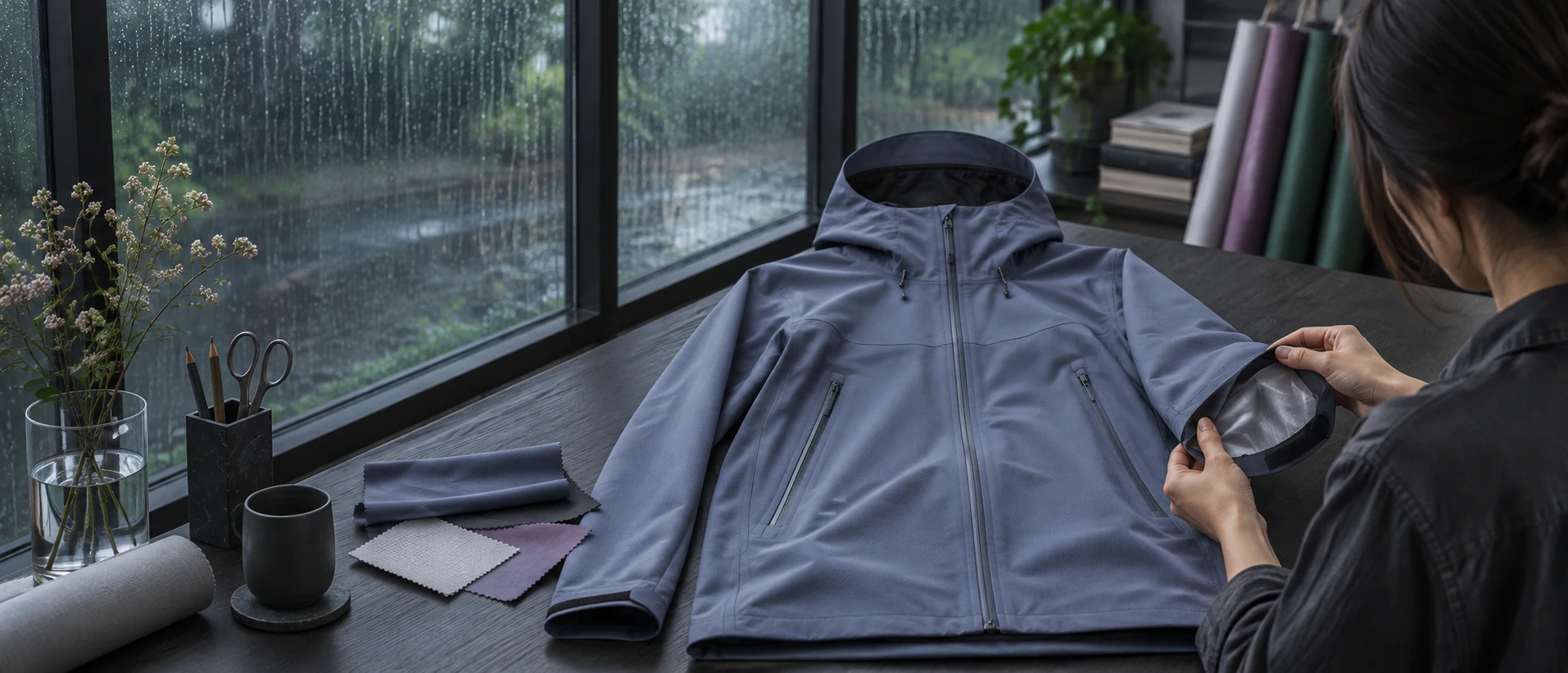
During garment review, inspect seam intersections, hood attachments, pockets, closures, cuffs and hem arrangements. Agree how the finished sample will be exposed to water and how observations will be recorded. If moisture appears inside, document its location and conditions before deciding whether the cause is a fabric defect, an assembly detail, an opening or internal moisture.
9. Build a waterproof-fabric brief that suppliers can quote
The best fabric comparison is traceable. Each candidate should have an identifiable swatch, a construction description, a report set and an approved garment sample. When a supplier changes the face fabric, membrane, backing or finish, record the change and decide which approvals need repeating.
| Brief field | What to write into the request |
|---|---|
| Intended use | Activity, exposure, expected layering and customer care |
| Face textile | Composition, yarn description, weave, mass and proposed colors |
| Barrier assembly | Coated or laminated structure, membrane identification and backing |
| Waterproof evidence | Target, method and edition, units, specimen condition and report scope |
| Repellency evidence | Method and agreed result in new and cared-for conditions |
| Breathability evidence | Method, edition and conditions for the actual assembly |
| Durability sequence | Washing, drying and any applicable mechanical preconditioning |
| Garment construction | Seam coverage, closure details and sample evaluation |
| Approval control | Swatch reference, report date, accepted sample and change procedure |
Set acceptance values with the laboratory and supplier for the intended product; this table supplies the fields rather than universal pass levels. If a quotation contains only a headline waterproof number, ask for the missing context before using it in a comparison spreadsheet.
Wisp's Storm Hardshell Jacket lists nylon or polyester shell options and can serve as a starting point for that discussion. The style name and options do not establish a numerical waterproof rating. Use the waterproof jacket specification guide to prepare the performance brief, then request a fabric and sample review with the intended market, use, quantity and approval requirements.
Frequently asked questions
Is nylon more waterproof than polyester?
Neither fiber name establishes the pressure resistance of a finished shell. Compare the actual barrier assembly and its test report, while assessing the face textiles against the physical and handling requirements of the range.
Does a higher spray rating mean a higher waterproof rating?
No direct conversion is available. Spray testing evaluates surface wetting; hydrostatic testing evaluates resistance to penetration under pressure. Ask for both when both properties are part of the product brief. [1][2]
Is a three-layer jacket always better than a two-layer jacket?
Layer count does not settle the choice. Confirm the construction, then compare the performance evidence, weight, fit, inside feel, care requirements and intended use of the complete samples.
Does wet-out prove that a membrane is leaking?
It does not prove leakage. Record where moisture appears and under what conditions, then evaluate the outer face, barrier, seams and openings separately. Wet-out and internal condensation should not automatically be treated as the same failure. [9]
Can a published fabric study prove a Wisp jacket's rating?
No. Research can explain mechanisms and guide test selection. A product claim needs evidence that applies to the material or finished garment actually being supplied, with the relevant conditions and scope.