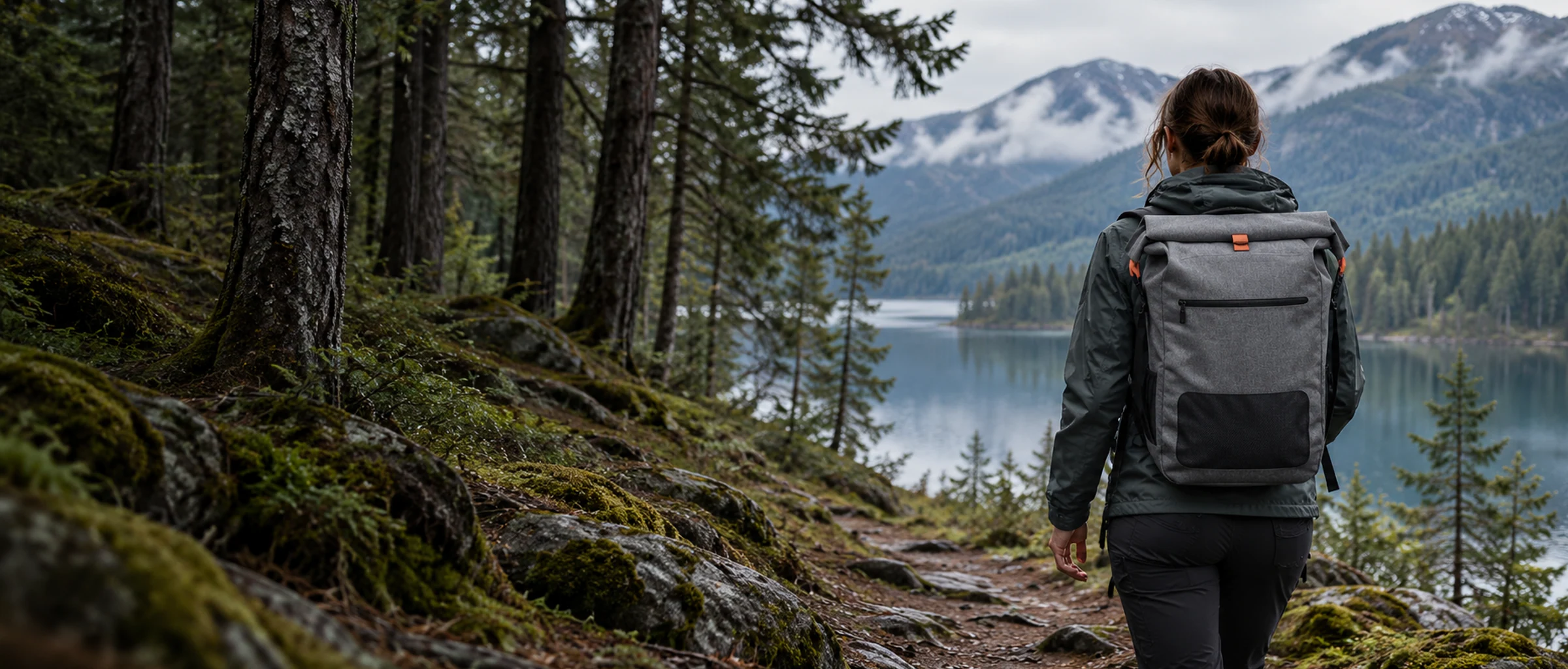
Choose a waterproof bag by the exposure it must handle, the way the opening closes and the load it will carry. TPU or PVC describes a material direction; the finished bag’s seams, closure and attachments determine what needs testing.
The Wisp Waterproof Bags collection brings together backpacks, fishing bags, travel formats and cycling bags. A useful purchasing brief separates these applications before comparing volume or price.
Define the exposure before choosing a closure
Daily rain, spray beside a boat and accidental immersion are different requirements. Describe the expected exposure and how the user will operate the bag. Then agree the appropriate test method, closure procedure and acceptance criteria for the selected sample.
| Feature | What to discuss | What to verify |
|---|---|---|
| Roll-top opening | Number of folds or rolls, usable opening and buckle arrangement | Closing procedure, packed capacity and leakage under the agreed test |
| Zipper opening | Zipper construction, end seals and ease of access | Performance of the complete closed opening, including its ends |
| Welded seams | Coated fabric, seam geometry and attachment locations | Seam quality and the finished bag under the agreed load and exposure |
| External pockets | Quick-access storage and drainage | Whether the pocket shares the main compartment’s protection level |
Ask whether any stated ingress-protection rating applies to a zipper component or to the complete bag. Check the report, tested configuration and closure instructions. A component rating cannot establish a whole-bag rating, and a water-jet rating should not be treated as an immersion claim.
Compare the complete TPU and PVC constructions
The catalog offers both TPU and PVC platforms. Ask for the base fabric, coating arrangement, thickness or weight, finish and reinforcement details for the exact version. Material names alone do not establish durability, environmental credentials or suitability for a specific temperature range.
The WP-001 25 L TPU Backpack has catalog dimensions of 30 × 15 × 68 cm. The PVC Backpack WP-036 lists 25 L and 32 × 16 × 61.5 cm. They offer two starting points for a sample comparison, with different proportions despite the same stated capacity.
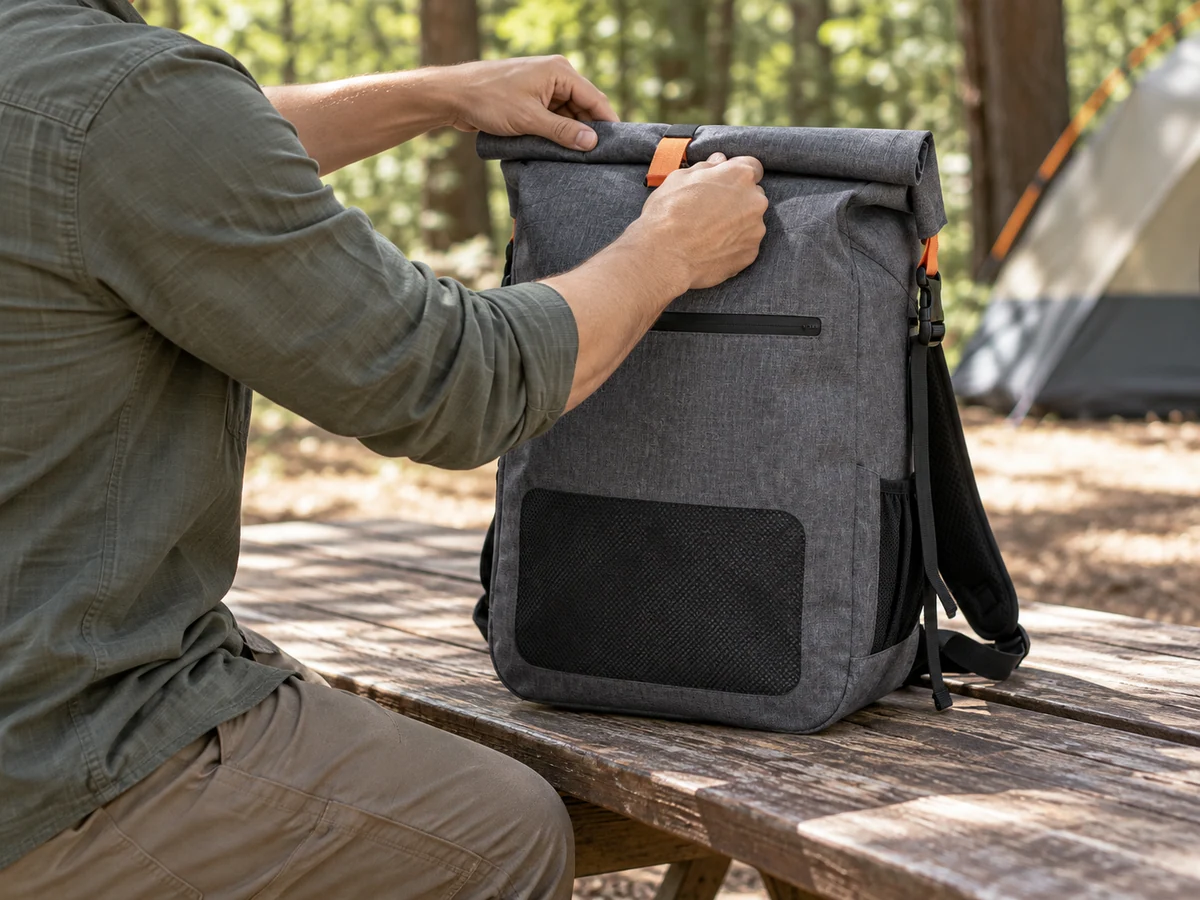
WP-001: 25 L, 30 × 15 × 68 cm, catalog-listed TPU. Confirm dimensions in the agreed closure state.
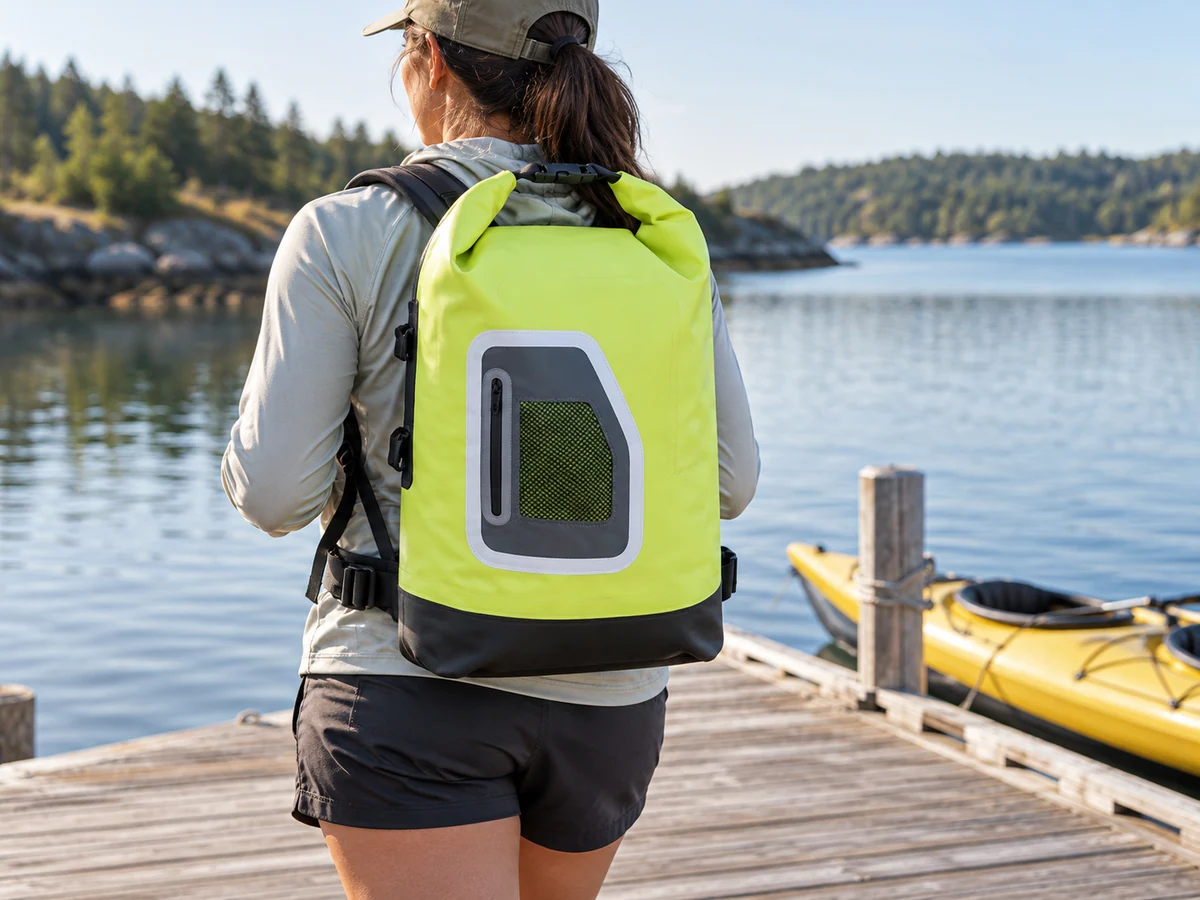
WP-036: 25 L, 32 × 16 × 61.5 cm, catalog-listed PVC. Equal nominal volume does not establish equal usable space.
Check usable capacity with the bag properly closed
A tall roll-top body needs room for its closure. Ask whether the listed height describes the bag open, laid flat or closed, and how the volume was established. Trial-pack the intended equipment, close the bag as instructed and check whether access and carrying remain comfortable.
The TPU Backpack WP-002 is listed at 28 L with dimensions of 28 × 18 × 70 cm. Use that information to shortlist a format, then confirm the actual packed shape. Do not calculate guaranteed capacity by multiplying the outside dimensions of a flexible bag.
Choose carrying details for the activity
A fishing bag needs an equipment layout that can be used at the water’s edge. The Fishing Kit Backpack WP-044 is a catalog-listed 25 L format at 30 × 16 × 51 cm. Check the intended tackle containers in the sample, external attachment points and the access sequence. Include any required protection for individual electronics in the brief.
Cycling bags need a separate fit check on the bicycle: frame clearance, steering movement, heel clearance and mounting security depend on the chosen position. Travel duffels need handle and shoulder-strap checks under the intended filled load. A shared fabric family does not make these carrying arrangements interchangeable.
If your range includes insulated bags, discuss thermal performance separately from water ingress. Agree loading, cooling media, ambient conditions and duration before making a cold-retention statement. Our cooler box and portable fridge guide explains the wider storage and cooling questions.
What to agree before bulk production
- Record the full material specification, closure components and relevant drawing revision.
- Approve the usable packed volume and dimensions with the closure fully operated.
- Set a filled-load procedure for handles, straps, buckles and mounting points.
- Agree water-exposure testing for the complete finished bag and identify any excluded pockets.
- Confirm branding placement, care instructions and packaging without interfering with seams or closure operation.